





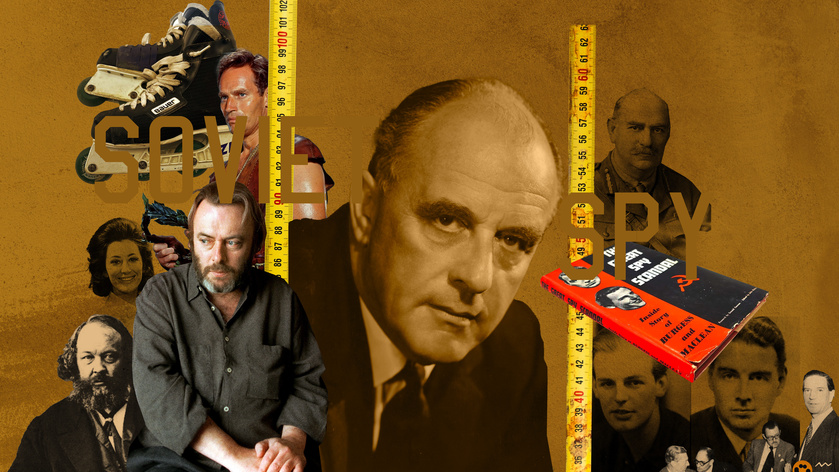
Lord (Victor) Rothschild - father of Jacob Rothschild, grandfather of Nat Rothschild - was a KGB spy. I don’t know about you but I think this is a pretty big deal. A British peer of the realm, supposedly working for the British intelligence services, was in fact a traitor and a double agent - or, indeed, a triple agent because he was also, inevitably, spying for Mossad.
But though reams have been written on the three most infamous double agents in 20th century British intelligence history - Philby, Burgess and Maclean - the treachery of Lord Rothschild remains largely unknown, despite the fact that Rothschild likely did more damage and betrayed more secrets than the other three spies put together. So how come he has been let off the hook?
This was one of the questions I was keen to ask this week’s Delingpod guest Roland Perry. Perry is the Australian professor and author who unmasked Rothschild in his painstakingly-researched book The Fifth Man. It was published thirty years ago and given the explosive nature of his material, you might have thought it would have sold in the millions - as did far less revelatory books like Peter Wright’s Spycatcher, which erroneously fingered MI5 head Roger Hollis as the Fifth Man. Instead, I was surprised to hear from Perry - who said I was just about the only interviewer in the last thirty years to take his research seriously - that the book’s sales scarcely exceeded five figures.
Really, though, I shouldn’t have been surprised at all. You only have to read Christopher Hitchens’s 1995 hatchet job in the impeccably left-liberal Establishment The London Review of Books to see where Perry came unstuck.
Roland Perry – who actually opens one of his chapters with the words ‘A shot rang out’ – would not know the difference between Bukharin and Bakunin, and makes the case that Victor Rothschild was a spy because he was a Jew. ‘He was never so committed to his country of birth and its established order. In fact, more than once when confronted with a conflict between race and country, he chose race.’ Well, why not come right out and say what’s on your mind?
I’m suspicious of any thesis that depends on such rhetorical fallacies as the argumentum ad indignationem and the appeal to ridicule; as I also am of one that the focuses on the style rather than the content. Hitchens deploys all three forms of trickery in this one paragraph, something I probably wouldn’t have noticed as a younger man in thrall to the cult of ‘the Hitch’, but which now strikes me as entirely characteristic of the man’s essential bogusness.
Like many Oxford PPE undergraduates - it’s how they’re trained to be - Christopher Hitchens was very good at appearing cleverer than he actually was. That ‘Bukharin and Bakunin’ swipe is calculated to achieve a number of effects. One is to boast (without any need to prove it) that Hitchens knows just as much as any man in the West ever did about the politics of the Soviet Union; another is to intimidate the reader, by laying Hitchens’s metaphorical socialist firebrand penis on the table with an impressive thwack, and declaring with a nicotine-and-whisky-ravaged drawl “And if YOU don’t know who Bukharin and Bakunin were, then perhaps you’d best quit the field now and leave it to those of us superior beings who do.”
I must confess I was familiar with neither. So I looked them up. Nikolai Bukharin was a Marxist revolutionary and theorist murdered in Stalin’s late Thirties purges. Mikhail Bakunin was an earlier revolutionary and anarchist who died in 1876. But I don’t see their relevance to the subject matter - was Lord (Victor) Rothschild or was he not a Soviet spy? - on which Hitchens purports authoritatively to be passing judgement. Had Hitchens actually read Perry’s book, rather than merely skimming it derisively for cherry-picked infelicities, he would have found more than enough carefully accumulated evidence to support its thesis. But it’s clear that he had made up his mind before he’d got any further than the cover blurb. The clue is in that snide insinuation that Perry is an anti-semite.
Having read the book and spoken to the author, I get the impression that Perry is the very opposite of an anti-semite. Had he been one, I doubt he would have bothered going on to write a celebratory biography of Australia’s greatest First World War general Sir John Monash, the son of Jewish immigrants from what is now Poland. But just suppose, for a moment, that Perry really were to the right of Heydrich, with similar views on the Jewish question, would this bias nullify his research on Rothschild? Hardly. To suggest otherwise is to fall prey to what I call the Hitler/Dogs Fallacy. See this essay - one of my finest - for further details. But if you want the short explanation, basically it’s this: just because Hitler likes dogs doesn’t mean that dogs aren’t likeable. Hitchens had probably pegged it by the time I named this fallacy. But I like to think that if he had heard it he would have used it all the time, probably passing it off as his own to impress all his literary mates (“Hey Mart, don’t you think that paragraph is a bit Hitler/Dogs”, “Salman. Stop being so bloody Hitler/Dogs, will you?”, “Julian. Jools baby. Jools. Listen a sec. I’ve just thought up this hilarious new fallacy…” etc).
And here’s another thing that Hitchens doesn’t seem to understand. If someone has done something wrong it ought not to matter one jot whether the perpetrator is black, Zoroastrian, transgender, gay or, as in this case, a Jewish billionaire from a famous bloodline: their identity doesn’t cancel the crime or entitle them to a more sympathetic hearing or render them immune from scrutiny and criticism. To think otherwise is to reject what is quite properly recognised as one of the most fundamental principles of a free and fair society, that of equality before the law.
As a graduate of Balliol College, Oxford, Hitchens really ought to have appreciated this entry-level point. All right, so he seems to have devoted more of his time there to revolutionary left-wing politics and hopping in and out of bed with at least two male future ministers in Margaret Thatcher’s cabinet than he did reading for his meretricious degree subject. But still, gentleman’s Third or no, Hitchens went on to spend the rest of his working life a) posing as a deep thinker and b) affecting to champion the rights of the ordinary working man. I wonder how the ordinary working man, had Hitchens ever met one, would have responded on being told: “Prison is for the likes of you and possibly, at a push, me. But definitely not for the likes of Lord Rothschild.”
Why not Lord Rothschild, though? There’s an interesting hint to part of the answer to this question buried in Perry’s book, published in its updated version under the title The Rothschilds, The KGB Masterspy & The Gay Royal Traitor. This occurs in his description of a true episode in which a trainee Russian spy, posing as a London embassy diplomat, is taken to various dinner parties so he can learn the nuances of English customs and mores. The spy blows his cover when, after a few drinks, he observes that Britain is in thrall to a Zionist conspiracy. The other guests are appalled at this social solecism - and the trainee agent is roundly rebuked at his subsequent debriefing, where he learns that in England such things are never said in polite society.
This scene rang true to me. Often over the years I’ve heard rumours that the British Establishment is anti-semitic. But in my experience, certainly in the upper-middle-class literary and political circles I tended to frequent when I was journalist, I found the case to be quite the opposite. To be Jewish was a bit like having gone to Eton: it meant, likely, that you were smart, well connected and worth cultivating. It most definitely wasn’t considered any form of social handicap.
Back then, I was still very much a Normie in my way of thinking. But even in my days of innocence that Jewish conundrum did give me pause. It was one of those glitch-in-the-matrix anomalies that niggle at you when you are not yet Awake and which can sometimes act as a stepping stone on your journey to awareness. My confusion went as follows: “Here I am with lots of friends who are either Jews or Jew-ish. I love them very much because they are witty, entertaining, articulate and they love me. They are also mostly prosperous, successful, well-balanced and plugged into an enviable network which not only gives them a special sense of belonging but which also will often give them a helping hand up the ladder just because of their happy accident of birth. So why, given all their manifest advantages, am I culturally required to view them as some kind of oppressed minority deserving of kid glove treatment? And why does something as harmless as even noticing that someone has a Jewish surname open you to the charge of being ‘anti-semitic’?”
It is human nature to notice differences. Say you were introduced to someone called de Lattre de Tassigny or Von Bismarck - or Pappadopoulopoulos, or Umbongowagawagaongugu, or Delingpole, even - at a party, you’d want to know more, wouldn’t you? Likely, you’d try not to put your foot in it by making your curiosity too obvious. But subconsciously you’d definitely be using the information to help form an assessment of the whole person. Sizing people up. It’s what we do. It’s what we have to do for, as much as anything else, self-protection. Do I like this person? Do I trust them? Could they hurt me - or benefit me - in any way? What are we likely to have in common? What should I avoid saying if I don’t want to cause offence? Yet apparently - so one gathers - you can’t do this if the person is called something like Steinowitz or Fischenburger, or if they’ve got a recognisable type of nose, or they speak with a particular type of accent and say things like “Oy vey!” You are supposed to pretend you haven’t noticed.
Who made this rule, you might wonder.
Whenever normal, natural, healthy human behaviour is pathologised and stigmatised or constrained, for whatever reason, that ought to be a massive red flag to anyone who can think straight. By ‘thinking straight’ I suppose what I mean is thinking with the unfiltered curiosity and guilelessness you associate with small children when they ask ‘embarrassing’ questions like: “Why is that man wearing a dress?” It means spotting when something doesn’t make sense - and then calling it out. Most of us are incapable of doing this much beyond the primary school stage of our lives. It’s because, past that stage, the education system has done its job and reduced us to the required state of collective stupidity. We think we’ve been educated. But what has actually happened is that our minds have been closed and we’ve been brainwashed into accepting as unquestionable truths a large number of excedingly dubious shibboleths.
One of them concerns ‘the Jews.’ We’ve been given permission to think that their humour is the funniest in the world, because it’s born of oppression or some such. We are encouraged to believe that there’s cultural cachet to be had in finding Larry David’s pathologically selfish antics ticklesome and charming rather than rebarbative. We’re allowed to be beguiled by certain Jewish social mores and traditions and quirks, as for example in that ubiquitous series of British Telecom ads in the 1980s where Maureen Lipman plays a lovable caricature of a Jewish grandmother, thrilled that her grandson has ‘got an ology’ in his exams. And of course, we’re free to recognise them as a) God’s Chosen People, b) as partial progenitors of all that is wondrous about our so called ‘Judaeo-Christian’ civilisation and c) as the hands-down, all time, summa cum laude winner of the Oppression Olympics. All these things - and more - are things you are allowed to notice.
But the list of things you are not allowed to notice is a deal longer. Yes, you can celebrate that Jews punch well above their weight in terms of Nobel Prizes won. But make a similar point about their similarly overweight dominance in fields like banking, the law, Hollywood, the music industry, chairmanship of the Federal Reserve and pornography, and suddenly you’re noticing stuff that will get you into trouble. Same with the religion itself. Yes, it’s fine that you know enough to recognise what a menorah looks like, that you might need to wear a tiny hat at your orthodox Jewish mate’s funeral, and that you mustn’t, except in clumsy jest, offer them a bacon sandwich. They certainly don’t want you asking any awkward questions, though, about the Satanic symbolism of the Star of David (as sported anachronistically and propagandistically by Charlton Heston in his chariot in Ben Hur) or what the Talmud has to say about Jesus or what the Noahide Laws have planned for you if you’re a Christian.
My beef here is not with the Jews themselves - most of whom bear as little responsibility for the world’s ills as the vast majority of non-Jews - but rather with the prevailing cultural narrative (the invention, of course, of The Cabal) which requires us all to pretend that they are a special case. This means that we are forced to live in a permanent state of cognitive dissonance. On the one hand, we’re repeatedly assured that we are all equal - men and women, gay and straight, black and white, and so on. On the other, we’re supposed simultaneously and unquestioningly to accept that there is one category of people who are exempt, for reasons supposedly so obvious we’re not even allowed to wonder what they might be.
Hmm. I could just about see this making a sort of sense were our daily experience to comprise such sights as: slave gangs of Ben Shapiro lookalikes in their trademark yarmulkes being forced to drag giant blocks of white marble up steep hilltops, the blocks then being connected to form gigantic swastikas; signs in pubs, golf clubs, even top international investment banks saying “No Jews, dogs, or Jews”; Jews in rags, Jews holding out beggars’ cups, Jews not having a single job in the City, the top law firms, BBC production departments, academe, the gold and diamond industries, the rag trade because they are just so heavily discriminated against.
But that’s not quite the case, is it? (Well, it is I suppose, if you believe what you read in the Daily and, even more so, theSunday Telegraph, now that they’ve been taken over by the fanatically zionist German media group Axel Springer.) Indeed, so very observably is it not the case that it’s almost as if They - that is, the shadowy forces which inflict these narratives on us - are deliberately taking the piss.
And indeed, of course, They are taking the piss. They relish the fact that, up to a point, we can tell we are being tortured and mocked with bizarre rules that make no sense but which we are yet compelled to follow. That, after all, was the essence of life in the Soviet Union - for which They, inevitably, were also responsible because They like to use the same playbook repeatedly. It’s a key part of Their control mechanism, messing with our heads, forcing us into a position where we have to believe two things simultaneously: the observable but forbidden reality and the officially endorsed fiction. A populace so confused that it can no longer trust its own senses is much easier to manipulate and contain. We are all, as I often say, under a spell.
So I suppose on one level we can’t really blame Christopher Hitchens for his red hot take that Lord Rothschild can’t have been a Soviet agent because muh anti-semitism. Hitchens was the product of an education system and a social milieu and a brainwashing framework which, over a lifetime, would have rendered any other response than his Pavlovian act of virtue signalling unthinkable. For Christopher Hitchens, see also: every other licensed gatekeeper in the literary trade who reviewed that book. They didn’t need to be told to pour cold water on Perry’s thesis. They did so instinctively because they all moved in the same circles. These circles comprised the kind of people that that trainee Russian spy upset with his remarks about a ‘Zionist conspiracy’ at those dinner parties. There are certain things that you just can’t say even if they are true.
My point, here, is not that everything is a Zionist conspiracy. (I’m much more taken, currently, with Mrs Heritage History’s and Peter Duke’s “It’s the Phoenicians” theory, as you probably know.) What I’m having a go at, rather, is the mindset that refuses to engage with the possibility that anyone Jewish might ever have done something wrong because even to countenance such a thing would render you guilty of the worst crime known to humanity, antisemitism. Eh? Isn’t that a bit like not taking a line on murder because that would be ‘murderist’? Or rape, because that would be ‘rapist’? To put it another way, either Lord Rothschild was a Soviet spy or he wasn’t. If your response to this question is to swerve it into a series of rambling ad homs impugning the author’s style and motives and alleged prejudices, you’re not really engaging with the issue, are you? In fact I’m starting to wonder whether Hitchens deserved even to scrape that Third.
I realise at this point that my “Did you know that Lord Rothschild was a Soviet spy?” piece has, at least temporarily, been hijacked by its sub-theme, viz: “Christopher Hitchens: what a dick!” But I’m afraid I can’t resist. One of the joys of becoming Awake is that iconoclastic frisson you experience on discovering that all those overrated celebrities you were encouraged, nay, almost press-ganged, to admire in your Normie days were in fact a bunch of liars, charlatans, sell-outs, cowards, wormtongues and child rapists in hock to the Forces of Darkness, and ergo deserving of nothing other than your contempt. Christopher Hitchens was definitely somewhere along that spectrum of disgustingness. I can see why his longsuffering brother Peter gets so incredibly pissed off whenever someone makes the unfavourable comparison. Imagine being a principled Christian - as Peter, for all his faults, most certainly is - and being told constantly ‘You’re not half the man your big brother was!” when his big brother was an atheistic poseur lounge-lizard with a Belial tongue, a plausible manner and all the moral fibre of a Phoenician dancing girl.
Sure, if ever I’d had to do a debate with ‘the Hitch’ he would have wiped the floor with me. But as I explain in more detail in No, I Don’t Want To Take Part In Your Stupid Debate this is why I hold ‘debate’ in such low esteem: it’s the domain, not of the truth-speaker but of the charismatic bullshitter. As Exhibit A, I present to you an apparent insight of Hitchens’s which is so famous that it actually has its own Wikipedia page: Hitchens’s razor.
“What can be asserted without evidence can also be dismissed without evidence.”
Sounds clever. If he chucked that one at you during a debate in his characteristic politely-restrained-because-I’m-clearly-speaking-to-an-idiot drawl you wouldn’t know how to respond. But isn’t that because he’s demanding the impossible? In the context of atheism, for example, he’s saying: “You can’t prove God exists so I rest my case.” It’s a victory, of sorts, but only a self-claimed victory: one that depends entirely on one’s acceptance of Hitchens’s narrowly materialist terms. If you look on YouTube, you’ll find compilations of so-called ‘Hitch Slaps’ - moments from The Hitch’s debating career where he is shown ‘owning’ his opponents with pithy put downs. But then, so could you have owned them if you spoke in that languid, de haut en bas, upper class English accent and your opponent was some hapless student in the audience, or a cartoonish blowhard like Sean Hannity, or a rabbi defending something easy to get cross about, like circumcision.
I’m not saying Hitchens didn’t have his moments. Of course it’s entertaining when he goes off on one about, say, the wrongness of female genital mutilation. Yes, I agree Hitch, I don’t think much of FGM either, but it’s a bit of a piss-easy target, no? Doesn’t exactly require much moral courage to sit there on a stage and pontificate about how utterly appalled you are about young girls having their clitoris cut off. But where was Hitchens on the really big stuff: the stuff that could cost you your job as a mainstream media commentator because it’s so far outside the Overton Window?
In case the answer wasn’t obvious: NOWHERE. Well of course he wasn’t because if Christopher Hitchens really had been the fearless revolutionary he pretended to be, he would never have got to be the feted, bestselling author, journalist, commentator, debater and public intellectual Christopher ‘The Hitch’ Hitchens. He would have been just another random nobody. On some level, whether cynically conscious or innocently sub conscious, Hitchens will have understood this, as all people who want to become successful do. This is how you keep your job as one of the Establishment’s licenced jesters: by knowing exactly how far to push it. So, in Hitchens’s case, you’re free to spend your early career criticising American foreign policy just so long as you never identify the figures who are actually behind American foreign policy; you can write a book criticising Mother Teresa - just so long as your criticism is merely that she’s an overzealous Roman Catholic, as opposed to, say, making the rather more significant criticism that she’s an agent of Satan heavily involved in the child trafficking industry… Christopher Hitchens - possibly his little bro, Peter, too; but definitely Christopher - is classic Limited Hangout.
Classic ‘Total Sell-out’ too, when you consider the position he adopted on 9/11, fully buying into Dubya’s utterly confected War On Terror. I suppose in fairness I ought to confess that for a large chunk of my journalistic career, I too believed the official narrative on 9/11 and heartily supported what I considered to be the righteous new crusade against the ‘menace’ of Fundamentalist Islam. The difference is, though, I changed my view and have since recanted. And while it’s true that Hitchens is no longer in a position to recant and hasn’t been since 2011, I’m inclined to think that even had he lived longer - he’d only be 77 if he hadn’t succumbed to cancer - he’d still be pushing the same old disingenuous Normie talking points to this day. I can’t imagine, for example, that he would have stood up to the vaccine tyranny. Still less can I imagine him being critical of the Israeli response to the October 7th ‘invasion’ nor of the obviously mendacious official narrative which, like the good little MSM gatekeeper he was, he would have swallowed and promoted wholesale.
But there’s really no need to have a go at Christopher Hitchens speculatively for things he might have got wrong had he still been alive. There is, after all, more than enough bad stuff he really did do - and for which he ought to be held to account. Foremost among these crimes, I suppose, though it’s so flagrant it’s scarcely worth mentioning, is all that posturing he did later in life gulling the impressionable - impressionable young men, especially, I suspect - into believing that if you wanted to be one of the cool kids atheism was the only option. Personally, I’m not so bothered by that one as I might be, because I suspect that God has already got that particularly issue sorted. No. The thing that bothers me much, much more about Christopher Hitchens - probably because I’m a fellow scribe and from a similar-ish class and education background - are what his naval officer father might have termed ‘Dereliction of Duty’ and ‘Cowardice in the Face of the Enemy.’
Let me explain. If you are a coach driver, driving groups of school kids to dinosaur theme parks and such like, your main job requirement is to deliver the noisome brats safely back to the collection point rather than to drive them over a cliff, tempting though that might be. If you are a fireman (not of that ‘firefighter’ nonsense for me: I’m old school), your job is to put out fires, not stand on the sidelines smoking a fag complaining how hot it is while your mates do all the ladder-climbing and extinguishing. Well, similar rules apply if you are a public intellectual who has earned fame and fortune by fearlessly speaking truth to power. To justify all that acclaim you’re getting, all those invitations to the top table, all those women who want to climb into bed with you, all those young men who want to be you, you do at the very least have to do a bit of actual fearless speaking of truth to power. Otherwise what you are is a cop-out and a fraud - and possibly even more useless than the coach driver who regularly drives schoolkids into ravines or the fireman too lazy to put out fires because your influence is greater and, ergo, so is the cost of your failure.
Among the many checks and balances that keep our civilisation honest - at least so Normies believe, and that’s what matters for this particular argument - are those feted cultural and political commentators who tell it like it is, without fear or favour. That’s why we value their opinions so highly and why they are so well paid: because they inform our opinions and help steer us to what we believe is ‘the truth.’
Christopher Hitchens didn’t do this. (NONE of them do this, actually, but that’s for another - or several other - columns.) And that bloated exercise in self-regarding, pseudo-informed, faux-intellectual, puffed up wankery he tossed off about the Cambridge spies and Lord Rothschild for the London Review of Books is but one of numerous examples of just what a phony the man was.
If I sound a bit bitter here, I suppose it’s because I AM bitter. Unlike Hitchens - who cunningly managed to check out so that he never had to see the consequences of his pusillanimity and moral and intellectual frivolity - I have to wake up daily, as do you, in a world on the brink of apocalyptic ruination. We are run, as I often say, by people who hate us and want either to kill us or enslave us. And They are considerably closer to achieving this Ordo ab Chao New World Order nightmare than they were in Hitchens’s indulged lifetime. They are on the verge of provoking the hot stage of the Third World War, in which millions of mostly Christian men will be ground more thoroughly into mince than even was countenanced in the days of the Somme. They are close to being able to strip away all of the freedoms we once not unreasonably accepted as our birthright: freedom to travel, freedom not to freeze or boil in our homes, freedom to eat food and drink water not adulterated with poison, freedom to benefit from the fruits of our labour…
Yet none of these horrors would be coming our way if enough of us had decided “No hang on, wait a second!” and stood up to do the right thing. What do I mean by doing the right thing? Let me leave you with you one tiny weeny example. Suppose you happen to be reviewing a book and it happens to implicate in a crime a senior member of one the so-called Satanic bloodline families behind all those nefarious schemes I mentioned in the previous paragraph to kill, enslave, torment, crush and control us because to Them we are nothing but ‘useless eaters.’ Well, here is what you don’t do in those circumstances if you don’t want to do the wrong thing. You don’t say to yourself: “It’s quite possibly true but I’m not even going to countenance the possibility that it might be because the Rothschilds have a lovely place in Corfu where I might get invited some day if I play my cards right and my publishers are Jewish and my editors are Jewish and a lot of my leading fellow scribes and friends are Jewish and, actually, my own mother was a Jew (I was most pleased to discover belatedly when I was 38) and anyway I just feel it’s distasteful and not comme il faut to raise such inconvenient questions about the people who run the world because they’re the ones, like it or not, who make the rules and set the tone and allow us our titbits of modest fame and fortune, so I think that on consideration here is what I’m going to do. I’m going to wave my ‘Antisemitism’ wand and just make the problem disappear, just like that.”
Postscript:
Apologies to those of you who read this piece - those few of you who actually made it to the end: well done! - and found it to be incomplete. That’s because my team accidentally published it before I’d finished it.
There’s just one other point I’d like to make. Speaking for myself - and quite a few of you, judging by the comments - I think that the question of whether or not Lord Rothschild was a Soviet spy is something of much more relevance to Normieworld than it is to Rabbithole world.
That is, as Tom Fryer put it pithily on my Telegram channel: “I think we’ve got that whole story the wrong way round. Rothschild didn’t work for MI6, the KGB or Mossad. They all worked for him.”
Yup. I think that’s exactly it. If you read Roland Perry’s book, you’ll read the not-unsympathetic account of a rich outsider compelled by a mix of high-mindedness, social alienation, religious and ethnic loyalties and distant parenting into betraying his own country. But this is because Perry is looking at things from a Normie perspective. He clearly doesn’t know who the bloodline families really are, or how they raise their children. He’s unaware of stuff like Satanism, the twelve year old rituals, the ‘hunts’ staged at their various castles, the ritual sacrifice. He’s unaware - to amplify Mrs Heritage History’s point, made elsewhere - that families like the Rothschilds do not think in terms of national loyalty and, consequently, it is invidious to accuse them of treachery. The Rothschilds et al are not subject to the rules of history that bind us ordinary folk. They create history, in the interests of their Boss. Who, unfortunately, isn’t God.