






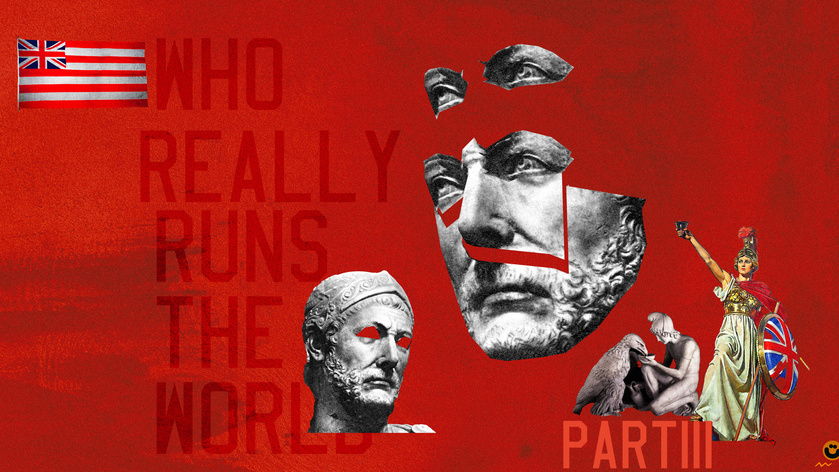
Who really runs the world?
There’s a certain kind of Awake person - grown-up, superior, lightly contemptuous of Awake newbies - who thinks there’s no point in asking this question.
“We’ll never know,” says Mister Snooty Pants. “And anyway, we’ve got more important things to be getting on with. We need to be thinking about solutions, not engaging in idle speculation.”
Happily for you I am not one of those people. Being puckish, irresponsible and relentlessly curious I care very much who it is that really runs the world. Also, I’m idealistic enough to believe that the truth matters; and optimistic enough to believe that if we keep pushing hard enough one day we’ll get there.
And now, with the help of my latest podcast guest, I think we’re a few steps closer.
Mrs Heritage History - or Mrs HH, as we shall call her from now on - is a grandmother from Idaho who acquired her monicker and her field of expertise quite by accident. Her background is engineering, not the liberal arts. But after giving up her job in order to home school her kids - “I didn’t want them turning into Beavis and Butthead” - she realised she’d better start brushing up on the subjects with which she was unfamiliar. And that was the point where she made the first of many discoveries.
Her first discovery was that history books published a century or more ago are more readable, informative and probably more accurate than those published recently. (You’ll find a selection of them here at her Heritage History online library). There’s a Normie-friendly explanation for this: narrative history, which is what used to be taught, has been largely replaced by interpretative history or historiography. Instead of understanding history as a series of stories about impressive people doing interesting things, we are now encouraged to focus on boring stuff like ‘underlying forces’, gender imbalances, ancient human rights violations, and so on.
But the problem actually runs deeper than this. History really now ought to be called Airbrushistory because that what it has been doing for at least a century: concealing from us the truth about our past at the behest of the shadowy figures who’ve been running the world since time immemorial. (Of whom more in a moment).
This is a huge subject and there’s no space to get into it here. For starters try my essay“How to Murder 100 Million People and Come out Smelling of Roses”, which shows how everything we’ve been taught about the origins of the two world wars is a lie and how Establishment historians have played a big part in the cover up. If their books regularly hit the bestseller lists or if they are a history professor - especially an Oxford history professor - then they’re more likely to be serving the Lie Machine’s interests than yours.
And if most modern history is bunk imagine how much worse things get the further back we go. Institutions like the Smithsonian - I don’t doubt that its British, French and German equivalents are just as guilty - have been systematically destroying inconvenient archaeological evidence since at least the mid-19th century. This is one of those many awkward facts which simply does not compute if you are Normie. Normies have seen Indiana Jones, been to the British Museum or the Louvre and quite possibly visited the pyramids too. As a result they have formed the unshakeable conviction that archaeologists are kinda cool, museum directors are immensely learned and distinguished and dispassionate, and that ancient history is something we get closer to understanding with each passing year as more and more evidence is unearthed by teams of selfless and dedicated soil-sifters.
But they’re mistaken, obvs, as Normies are about most things. Archaeology, museums, ancient history: anyone involved in these fields at the higher levels is a professional liar, just like all palaeontologists are all professional liars. It’s the way of the world: if you want to get on you’ve got to play the game.
Here’s a recent post from Mrs HH illustrating my point:
https://substack.com/@northidaholocal/note/c-319908069
Can it really be possible that the ancient past remains so dangerous to our dark overlords that they have to conceal it from us? George Orwell - who was probably one of Them - gave the game away: “Who controls the past controls the future; who controls the present controls the past.” In other words, there are secrets buried in the past which, if they got into the wrong hands - ie our hands - might make it harder for our dark overlords to keep us in check.
Yes, but WHAT, James? What?
Well, I’m guessing - and it is only a semi-educated guess - that one of them might be about their relationship to the Nephilim described in Genesis 6. The Smithsonian has been particularly assiduous in destroying all the giants’ skeletons quite frequently unearthed by Americans - and reported in local newspapers - in the 19th Century. Would this perhaps be because their bones provide physical evidence of the descendants of the interbreeding between fallen angels and the daughters of men, resulting in the so-called ‘mighty men’?
Another secret might be - as shown in revelation-of-the-method movies like the Indiana Jones series where, at the end, the Ark of the Covenant is consigned to a US government storage depot - that our ancient ancestors had access to artefacts, technologies or occultic skills which rendered them almost superhuman. There are rumours - which I’d love to explore further on a podcast if anyone can recommend someone credible - that one of the main reasons for the invasion of Iraq in the Second Gulf War was so that occultists like Hillary Clinton could get their witchy claws on the lost magical treasures of Mesopotamia. Gilgamesh’s sword, and such like.
Then, of course, there’s the possibility that there were civilisations far older than any recognised by mainstream archaeologists. Atlantis, for example, which I covered recently in a podcast episode with the charming and articulate Michael Le Flem. Or the lost ice Age civilisations championed by Graham Hancock and which I would believe in much more if a) he hadn’t been given his own series on Cabal Brainwash Central (aka Netflix) and b) didn’t appear regularly on Joe Rogan. Then again, he has been ‘debunked’ by Professor Dave, so that’s a point in his favour.
But when it comes to ‘conspiracy theories’ about our ancient past, I have yet to come upon one more plausible, compelling and erudite than the one advanced by Mrs HH, with able support from the magnificent Peter Duke.
It concerns the Phoenicians.
Now I don’t know about you but I know remarkably little about the Phoenicians. Until I read Mrs HH’s and Peter Duke’s research I had assumed that this was because they weren’t that significant: certainly not in the league of all the other ancient civilisations we’re taught about in school or which crop up everywhere from pop songs (‘Walk Like An Egyptian’, etc) to movies like Ben Hur, Spartacus, The 300, Gladiator etc.
We’re most of us so familiar with the Ancient Egyptians that we can identify their gods: Thoth with his distinctive Sacred Ibis curved beak; jackal-headed Anubis; Horus, the falcon. We know about Tutankhamen and the Mummy’s Curse. Ancient Egyptian symbols carry intellectual heft, as you can see by the way they are deployed on the niche BBC quiz show Only Connect - the hieroglyph-themed categories include ‘Horned viper’, ‘two reeds’, ‘lion’ ‘twisted flax’ etc - so that viewers can remind themselves how erudite they are in cherishing such details.
As for the Ancient Greeks and, even more so, the Romans - is there anything that we actually don’t know about them? The elite-educated among us have been trained to speak their language and quote their aphorisms. We know not just the names of their entire pantheon, but their characteristics (“grey eyed Athena”, etc). We’ve studied plays about them - Anthony and Cleopatra; Julius Caesar; maybe even Antigone - at school. We know about their history, their traditions, their battle tactics, their sexual preferences, their literature. Everyone (well, apart from me) has seen the Odyssey. Some people have even read the book.
The Phoenicians, though? There’s only one Phoenician that we’ve likely even heard of - Hannibal - and we probably didn’t even realise that Elephant Man was a Phoenician, nor that Carthage, whence he came, was one of the great Phoenician cities (along with Tyre, Sidon and - who knew? - the port in Spain the Phoenicians called Agadir and which we now call Cadiz).
Once you’re aware that Carthage was Phoenician you might manage to scrape a few other details from the recesses of your memory. The phrase “Delenda est Carthago”, for example. This was how Cato the Elder (234-149 BC) reputedly ended all his speeches in the Roman Senate. [Actually, I learn from Wikipedia, he used a less pithy phrase “Ceterum (autem) censeo Carthaginem esse delendam”, but it carries the same meaning]. It means “Carthage must be destroyed,” which gives you an idea of how little love was lost between the Romans and the Phoenicians in the days of the Republic, when they fought the Punic wars. The Roman phrase ‘Punica fides’ - ‘Punic faith’ - was synonymous with treachery.
So: Hannibal; elephants; Cannae; and a couple of Latin phrases: it’s really not much to show in the collective memory, is it, for a civilisation that dominated the Mediterranean basin for more than a thousand years? Which leads, inexorably, to one of two broad possible conclusions. The first is: “Phoenicians? Nah. Nothing to see here. They were never in the Premier League of ancient civilisations.” And the second is: “There has been a massive cover up.”
After speaking to Mrs Heritage History, I’m going with the second. We’re talking, after all, about a civilisation that: dominated the world’s trade routes; was technologically superior in many key domains from mining to navigation to shipbuilding; controlled resources including gold, silver and tin mining, as well as the Lebanon cedars used for ship-building and also the papyrus trade thanks to its literary headquarters at Byblos; was stupendously wealthy - see all of the above; dominated the world’s intelligence system, thanks to its presence in all the world’s entrepots; and almost impossible to defeat militarily because, apart from strongholds like Carthage, it held no major territory because a bit like the modern Jews (excepting the state of Israel) its people were at once everywhere and nowhere, visible and invisible.
Could a civilisation as advanced, supple, rich, sophisticated, knowledgable and ubiquitous really just have vanished into the ether?
No, of course it couldn’t and didn’t. It just went underground. This it could do thanks to another secret weapon it shares with modern Jews: matrilineal descendancy. That is, it could marry its daughters into the royal houses of all its rival civilisations, and subvert their traditions and influence their policies, without the host culture even noticing that it had fallen victim to a bloodless but hostile takeover. On the surface, the Romans would remain Roman; the Egyptians, Egyptian; the Minoans, Minoan; the Persians, Persian; and so on. Underneath, they were - not the ordinary folk, note; just the ruling elites - Phoenician.
For a truly fascinating, in-depth digression on this I cannot recommend highly enough this thoughtful essay by Thoughts From The Taverna. Taverna (as I hope he doesn’t mind me calling him for short) has noticed that the Frank Herbert series of Dune sci-fi novels tell you all about the Phoenician control structure through the ‘meta-layer’ narrative device of the Bene Gesserit. The Bene Gesserit are the ancient priestly class, all women, who secretly run the world from behind the scenes.
Here’s an extract from his piece, describing how it works:
When Mrs. Heritage History examined the genealogies embedded in ancient histories, she found patterns that certain families in Greece, Rome, and beyond traced back to Phoenician intermarriage generations earlier. Pericles, the controversial Athenian statesman, came from a family that descended from the “tyrant of Syracuse“. Tyrantbeing a Phoenician-derived term from the city-state Tyre. These were outcomes that were planned centuries earlier. Once, again, thinking in centuries not decades.
The Bene Gesserit breeding program is this practice made explicit. Thousands of years of selective pairing to produce a specific genetic outcome. The Kwisatz Haderach is the culmination. But the method which is patient, multi-generational, and hidden from those being bred are completely identical.
Besides conquest through dynastic marriage, the Phoenicians also gained power through the cruder method of bribery and corruption. This, argues Mrs HH, was how the Phoenicians took over Rome. They had lost the three Punic wars - ending with the total destruction of Carthage and, famously, the poisoning of its wells and the salting of its earth - but they won the peace by sneaking through the back door. Julius Caesar established his reputation in Phoenician-controlled Spain; later he was bankrolled by figures like Crassus - who gave us the word ‘crass’: that’s how delightful he was - who was in turn in the pocket of the Phoenicians. The civil wars which brought the Roman Republic to an end have been presented to us as a struggle between the people (represented by Julius Caesar) and the entrenched elites. But that’s the kind of positive spin you get when the victors are in control of the narrative. What those wars were really about, per Mrs HH, was a Phoenician power grab: extending the voter base beyond the Roman city to the Italian provinces (where the Phoenician influence was stronger); creating a standing army of professionals (as opposed to armed citizens) and therefore a mercenary body capable of acting against the populace’s interests.
Julius Caesar, you may or may not know, was a massive pederast, bum bandit and all round perve. This is significant because so were the Phoenicians (as, by the way, Romans generally weren’t in the days of the Republic. The debauchery came later). They raped both male and female children from a very young age; they were sexually profligate and adept (the dancing girls of Cadiz were particularly notorious: every fashionable Roman household had them at their parties); and when not having sex with their children they were busy killing them in ritual sacrifices to gods such as Baal Hammon and Tanit. As Phoenician mothers carried their first born to the slaughter, placing their child into the outstretched palms of a bull-like idol whence the infant would tumble screaming into the fire, they were expected to show no emotion. If they shed even a single tear, I learned from a podcast with Scipio Eruditus, the sacrifice would have been deemed invalid by the priests.
Up until the second half of 20th century, the Phoenicians’ penchant for human sacrifice was well understood by scholars. And by archeologists who found evidence of the murdered infants at sacrificial sites, known as tophets, everywhere from Carthage to Sicily, Sardinia and Malta. But then it became fashionable to explain away the child sacrifice as ‘racist’ propaganda on the part of the Greeks and Romans against their traditional enemies. If you want a quick chortle, do have a read of this piece in which an Oxford Classics professor, Dr Josephine Quinn, attempts to excuse child sacrifice on the grounds of autres temps, autre moeurs.
‘It’s very difficult for us to recapture people’s motivations for carrying out this practice or why parents would agree to it, but it’s worth trying. ‘Perhaps it was out of profound religious piety, or a sense that the good the sacrifice could bring the family or community as a whole outweighed the life of the child. ‘We have to remember the high level of mortality among children – it would have been sensible for parents not to get too attached to a child that might well not make its first birthday.’
Dr Quinn added: ‘We think of it as a slander because we view it in our own terms. But people looked at it differently 2,500 years ago. ‘Indeed, contemporary Greek and Roman writers tended to describe the practice as more of an eccentricity or historical oddity – they’re not actually very critical.
Yeah. That’ll be it. The reason we are disgusted with the idea of burning babies alive is because we’ve been rendered soft by low infant mortality rates and because we no longer understand how important it can be to appease the dark gods by slaughtering children at their shrines.
I wonder if Dr Quinn is herself of Phoenician heritage. She’s certainly talking like one here but probably only she and her fellow Phoenicians would know if she were. That’s how the game works: only people who are in the club know who the actual members are. The rest of us just have to rely on educated guesswork.
But there are clues. One of them concerns a phrase you quite often hear in conspiracy circles: “signs and symbols will be Their undoing.” [I’ve initial capped that pronoun as is my wont]. That’s because, as you may have noticed, They have a somewhat conflicted approach towards self-revelation. On the one hand, They like flying totally under the radar and operating in the deepest, dankest secrecy. On the other, They have to show you who They really are because Their religious obligations and Their inner sense of scornful, mocking superiority compel them to do so. They’re like James Blunt in his latest, creepy but revealing pop video.
Hence the red and white stripes on the US flag, which also appear on the East India Company flag and which also appeared on the sails of Phoenician trading vessels. Hence the Pillars of Hercules which appear on the Spanish flag, a nod to the fact that it was the Phoenicians who controlled the gateway to the Atlantic - and were likely to-ing and fro-ing to the Americas long before Columbus (which is why the Smithsonian Institute had to destroy so many of the ancient statues reported on by early European explorers of America). Hence the fact that nominally Christian countries like the US, the UK and France are yet represented by pagan goddesses - Columbia, Britannia, Marianne - who are just rebadged versions of the Phoenician goddess Astarte (aka Isis; Cybele). For more details see here.
There are clues everywhere, if you know where to look. One of the more egregious displays of Phoenician iconography can be found on the Mellon Auditorium in Washington DC. Passers-by glancing up at the pediment above this 1935 neoclassical building will likely assume that the semi-naked figures sculpted in limestone represent something wholesome and uplifting from Ancient History, befitting the US capital’s status as the New Rome. Spoiler: no they don’t. You’ll have to read The Duke Report’s essay for the full gobsmacking details. But essentially, that pediment is a paean to those delightful Phoenician practices of child-kidnapping, rape and pederasty. Which is why, argues Peter Duke, the elites use the building for enacting legislation in which the state seizes boys from their parents and sends them off to be metaphorically sodomised in the various foreign wars it has instigated.
This is an endlessly fascinating subject. Books - I hope - will be written on it because there’s so much to say and it draws together so many threads. My podcast with Mrs HH barely scratches the surface. But it will whet your appetite for further research and, I think, will go some way towards answering questions that hitherto you’ve been ill-equipped to answer. Such as the one I posed in the title about “Who Really Runs The World?”
It’s quite a divisive one in Conspiracy World because people tend to be very defensive about their preferred positions - and are correspondingly aggressive towards those who hold the ‘wrong’ view. The “it’s the Black Nobility”, “it’s the Jesuits” and “it’s the City of London” camps consider themselves mightily superior to the “it’s the Jews” camp. The “it’s the Jews” camp, meanwhile, just think the others are mealy-mouthed cowards who won’t acknowledge the Elephant in the Room. Personally, I’ve always been a bit wary about pinning my colours to any one particular mast, not so much because I’m a pusillanimous girlie but because I’ve found merit in all the different factions’ cases. What I’ve been lacking is the grand unifying conspiracy theory that enables me to have my cake and eat it by agreeing with everyone.
Now, thanks to Mrs HH’s Phoenician theory, I think I just about can. On the subject of ‘the Jews’, for example: it has always struck me as a bit desperate when people insist it’s ‘not the Jews’, when you only have to look at the banking, music and film industries to realise that it has to be, a bit. At the same time, though, the notion that it’s all ‘the Jews’ has long struck me as similarly absurd, because clearly some of the most powerful individuals and families throughout history right up to the present are not Jewish.
No, it’s not just the Black Nobility. Or the freemasons. Or the Jesuits. Or the City of London. Or the Jews. It’s ALL of them because, au fond, they are all Phoenicians.