Some people call the Covid scam the greatest crime in history. But I beg to differ. I think the two events that steal the crown are the First and Second World Wars, both of them entirely unnecessary, both of them funded and orchestrated by the same kind of people responsible for the fake pandemic and all the deaths and injuries from those safe and effective vaccines.
The First World War claimed an estimated 15 to 22 million lives, with another 23 million wounded. The Second World War claimed an estimated 70 to 85 million deaths, with another 15 to 25 million wounded. I got these figures from Wikipedia, so they may not be accurate. But I think we can agree that the two World Wars were the most devastating events in history, not only in terms of lives lost or bodies maimed, but also in terms of the social upheavals (marriages destroyed, families torn apart, communities dispersed, borders reshaped, livelihoods disrupted, psyches fractured) and the physical damage caused to beloved homes and irreplaceable architectural heritage.
Given that all this carnage was planned, arranged and successfully executed by a small group of identifiable conspirators - and it was - the question that naturally arises is: how did They get away with it?
Or, to put it another way: if you had been part of the elite circle responsible for massacring and dismembering millions and millions of innocent people, what measures would you have taken to persuade the survivors that this bloodbath was in fact a jolly good thing for which we should all be quietly grateful?
The reason I ask is a fascinating book I’m reading called Two World Wars And Hitler: Who Was Responsible? by Jim Macgregor and John O’Dowd. It convincingly demonstrates that the approved narrative on the world wars and their origins is a pack of lies. No, they weren’t started by nasty Germans with silly moustaches. They were orchestrated by a cabal of English and American financiers, aristocrats, businessmen and politicians who weren’t remotely bothered by the millions of lives that would be lost or the lasting damage that would be done. All this elite secret society cared about was destroying Germany (and, to a lesser extent, Russia) which it saw as economic threats - and then reaping the profits and exploiting the geopolitical gains once the carnage was over.
This isn’t exactly news by the way. It follows on from the work of Carol Quigley, Anthony Sutton, Guido Preparata and, before them, of historians such as the American Harry Elmer Barnes. In his 1926 book The Genesis of the War, Barnes became one of the first openly to question the ‘Germany bad’ narrative and poured scorn on the ‘court history’ of the mostly Oxford-based British academics claiming otherwise.
Barnes wrote:
There is no evidence that any responsible element in Germany in 1914 desired a world war, and the Kaiser worked harder than any other European statesman during the crisis to avert a general European conflagration.
But if this is really the case, how come so few of us are aware of it?
Mainly because the people and institutions who might have told us were already bought and paid for.
One of the key reasons for the success of this secret society - known in the early days as the Milner Group, after one of its more assiduous members, Alfred (later Lord) Milner - was that it controlled the financial system, the media and academe.
If it wanted a politician put in his place or needed the public whipped up into a frenzy on a particular issue, it could rely on papers like the Times (whose editor for 30 years, Geoffrey Dawson, was a close friend of Milner’s) to summon up a thundering editorial.
If it needed any figures of influence to be bribed it could rely on the bottomless pockets of the sympathetic Lord Rothschild (“Natty” to his friends) and his various banking fiefdoms in London and New York.
If it required royal support, it could call on first on the dissolute and profligate debauchee Edward VII (aka ‘Bertie’) and later on his son George V, both of them enthusiastic members of the club.
And when it needed tame stenographers to put a favourable gloss on all these shenanigans, it could call on the so-called ‘court historians’. These were the historians who, often in return for an Oxford professorship guaranteed to burnish their prestige and the virtual certainty of handsome book sales, were happy to prostitute themselves by promoting the official line and never asking awkward questions.
Any bestselling historian you’ve heard of, especially if he has ever held an Oxford chair, is almost certainly a ‘court historian.’
As Macgregor and O’Dowd write:
“It is a sad indictment of many academic historians today that they are all too accepting of the mainstream history narrative [….] Dependent for their salaries, research funding and future careers, the vast majority toe the official line. Those few who deviate from the carefully prepared ‘court history’ script are dismissed, deemed unemployable elsewhere in academia, and their careers and livelihoods effectively ruined.”
So this was the state of Britain - and the US: at the higher levels, they were joined at the hip - in the early Twentieth century. Does it sound or look vaguely familiar? It should do for the world we inhabit now is run by the same kind of people, with the same world domination agenda, using the same social programming/brainwashing techniques.
Once you are familiar with these techniques it becomes much easier to spot them retrospectively. For example, one of the classic tricks in the run up to a pre-planned war is to persuade the populace that war is something that they want and need - or that it is, at the very least, inevitable. The last thing you want is the mass of ‘public opinion’ going: “Wait a second. What’s going on here?? We didn’t ask for any of this.”
Luckily, public opinion is easily malleable. We got a taste of this recently during the Ukraine/Russia conflict, when opinion formers started pronouncing Kiev “Kyiv”, when a coke-snorting, playing-the-piano-with-his-penis comedian with only one green t-shirt in his wardrobe was suddenly being feted in Westminster and in all the newspapers as the world’s most heroic and principled leader, when villagers and trendy vicars who couldn’t place Ukraine on a map suddenly took it on themselves to attach blue and yellow flags to their homes and spires.
Here the mind control experts were employing techniques honed in their preparations for the First World War. Their big challenge in the run-up to August 1914 was that the British people had no particular beef with the Germans. Germany was seen as stolid but civilised, sensible and a nice place to go for your spa treatment. It was the French who were our natural enemies.
But little by little from the early 1900s onward, the British were persuaded by their bent politicians and media that Germany was their true enemy. Dire warnings were issued about the expansion of the German navy (which in reality was only enlarging itself because it could see what was coming); trivial incidents such as the 1911 “Morocco Crisis”, when a tiny German gunboat tried making a feeble protest against provocative Allied manoeuvring in supposedly neutral Morocco, were blown up by the newspapers as acts of inexcusable belligerence. [See also: the ‘Gulf of Tonkin incident’, which the Americans faked as their pretext for starting the Vietnam War]. By the time Britain declared war in August 1914, the populace had been worked up into such a pitch of Germanophobia that furious mobs roamed the streets in search of German targets to destroy, be they Bechstein pianos or, even less excusably, dachshund pets, which in a number of recorded incidents were stoned or beaten to death.
Even then, though, killing their Anglo-Saxon brethren did not come naturally to either side. This was most famously illustrated by the Christmas Truce of 1914 when tens of thousands of German and British troops at points along the Front met in No Man’s Land to exchange cigarettes, drink and souvenirs.
The scene is described here. It’s interesting to note that in most of the contemporary accounts quoted, it appears to have been the Germans who initiated the truce.
“It was a beautiful moonlit night, frost on the ground, white everywhere,” reported Private Albert Moren of the Second Queen’s Regiment. “About seven or eight in the evening there was a lot of commotion in the German trenches and there were these lights – I don’t know what they were.
“And then they sang ‘Silent Night’ – ‘Stille Nacht’. I shall never forget it; it was one of the highlights of my life. What a beautiful tune.”
The image of Germans lighting candles in their trenches and the sounds of their gentle singing drifting across the killing fields of No Man’s Land has become iconic.
Along the line, German soldiers held up white flags, or messages asking the Tommies facing them not to shoot. Men that had been engaged in desperate fighting days or even hours before had begun to feel illuminated by the Christmas spirit.
Soon they were singing together, trading jokes and the odd jovial insult or two.
Marmaduke Walkinton of the London Regiment described the scene: “A German said, ‘Tomorrow you no shoot, we no shoot.’ And the morning came, and we didn’t shoot, and they didn’t shoot.
“So then we began to pop our heads over the side and jump down quickly in case they shot but they didn’t. And then we saw a German standing up, waving his arms, and we didn’t shoot, and so it gradually grew.”
In at least one sector, there was also an impromptu game of football.
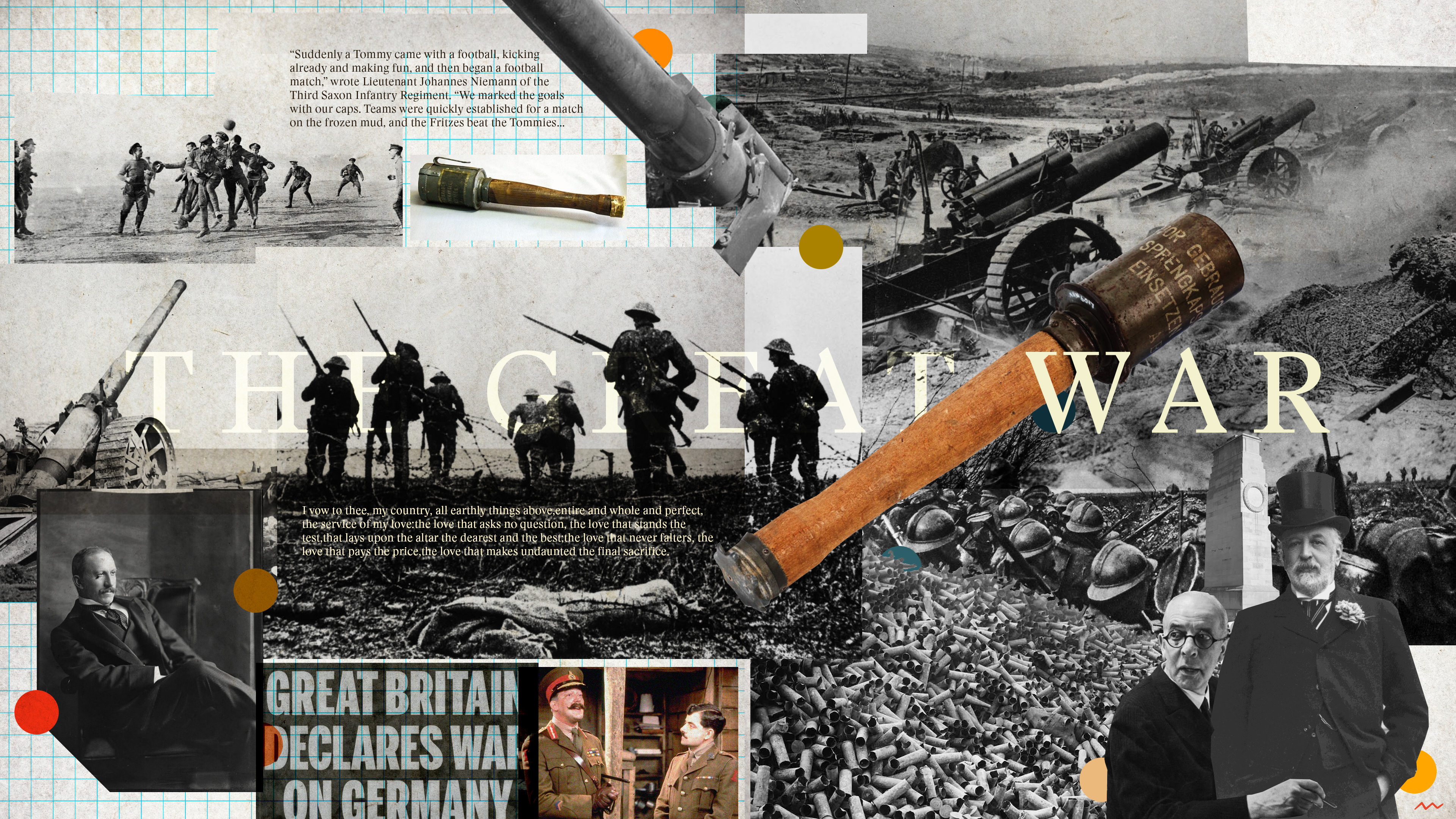
“Suddenly a Tommy came with a football, kicking already and making fun, and then began a football match,” wrote Lieutenant Johannes Niemann of the 133rd Saxon Infantry Regiment. “We marked the goals with our caps. Teams were quickly established for a match on the frozen mud, and the Fritzes beat the Tommies 3-2.”
Perhaps it won’t at all surprise you to learn that The Powers That Be weren’t remotely happy with this. They wanted slaughter not mutual love and understanding. Though no punishments were handed down for this unsanctioned fraternisation, measures were enforced to ensure it never happened again. First, the troops were moved to different sections of the line, to reduce the likelihood of their feeling residual kinship with the enemy units posted opposite. Secondly, casualty records across the front were regularly scrutinised so that senior officers could spot mini cease fires.
If one was detected, raids and patrols would be organised to foster the correct “fighting spirit” in troops.
It’s probably worth my reiterating the point that under most circumstances, people - even young men of ‘fighting age’ - would rather have a friendly chat than kill one another. To get them to kill requires relentless conditioning. And that conditioning is not an organic thing that arises from natural circumstances. It has to be directed from above.
Which isn’t, of course, the way we’re taught about war at school. Especially not about the First and Second World Wars which are invariably sold to us as examples of ‘just wars’ which ennobled all those who fought on the ‘right’ side in them.
At my fairly typical English public school, Malvern, this celebration of the glorious dead reached its apotheosis in the annual Remembrance Sunday service, which was taken more seriously than any other event in the school calendar. The school Corps lined up in military formation in front of the college war memorial (St George). A two minute’s silence was observed for the school’s fallen (462 in the First War; 249 in the Second). The Last Post was blown by a bugler from the rooftops. It was all very solemn and quite moving. In my day there were still plenty of Old Boys around who had served in the war, and whom you could see standing stiffly in their British Warms blinking back their tears at memories of the friends they had lost in combat.
What I hadn’t realised at the time is that this ceremonial was and is all part of the conditioning process. Sure we were honouring the dead. But we were also being brainwashed with a number of subliminal messages which I now realise were not just false but dangerous.
I think, for example, of how I would find it impossible to sing, without a catch in my voice, those lines from that classic Remembrance Day hymn, I Vow To Thee My Country. It’s sung to one of the most poignant and moving tunes in the English hymnal, taken from the Jupiter movement of Gustav Holst’s Planets Suite.
I vow to thee, my country, all earthly things above,
entire and whole and perfect, the service of my love:
the love that asks no question, the love that stands the test,
that lays upon the altar the dearest and the best;
the love that never falters, the love that pays the price,
the love that makes undaunted the final sacrifice.
But wait. What is really going on here?
Perhaps it’s not a coincidence that the author of those lines was a senior British diplomat named Sir Cecil Spring Rice. Shortly before the war, Rice was posted to Washington as Ambassador to the US, his primary mission being to persuade Woodrow Wilson’s administration to abandon its position of neutrality and take sides against Germany. Rice would never have got the job unless he had been entirely sympathetic to the Milner group’s aims.
So here we have an example of one of the (albeit junior) architects of the First World War later being enlisted - a bit like the capable Mr Wolf in Pulp Fiction - to help with the clean up operation. Operation Turd Polish, as it really ought to have been known.
The commission might have gone like this: “Cecil, old boy. D’ye remember that splendid little poem you wrote just before the war, Urbs Dei, about what a jolly marvellous thing it is when a chap dies for his country? We wondered whether you could spruce it up to make it a kind of national anthem for the Fallen. Maybe if you lost some of the ‘thunder of the guns’ stuff in the first verse - still a bit raw, that - and made it a bit more vague and poetic. What we’re after is a proper tearjerker, which chokes you up every time you hear it. But also something that conveys the important message that your country’s call demands unquestioning obedience and that if you do end up getting the chop, well it’s no bad thing because of love, sacrifice, being tested, and all that.”
No. I know it didn’t really happen quite as I’ve described. But I hope you will forgive my poetic licence in pursuit of my broader point, viz: one of the chaps whose job it was to ensure that thousands and thousands more young men (in this case American volunteers) were fed into the meat grinder also wrote the anthem explaining how totally marvellous and noble it was to die in this way.
I’m similarly sceptical of the oft-quoted lines from Lawrence Binyon’s For The Fallen.
They shall grow not old, as we that are left grow old:
Age shall not weary them, nor the years condemn.
At the going down of the sun and in the morning
We will remember them.
Yes, of course, it’s comforting to think of the war dead being frozen in a state of eternal youth andbeing perpetually memorialised as a kind of perk for having had their lives cut so brutally short. But though I’ve no doubt Binyon’s sentiments are sincere and heartfelt, they also constitute the most spectacular propaganda win for people who actually caused all those premature deaths.
As Horace well knew when he wrote the sarcastic lines “Dulce et decorum est pro patria mori” (which he only survived to write because he’d taken the sensible decision to run away at the Battle of Philippi), dying for your country has nothing to recommend it.
What both Rice’s and Binyon’s verses serve to do is gloss over this fact with a layer of slightly mawkish sentiment. Yes, it’s a lovely thought, and perhaps a way of dealing with loss by presenting sacrificial death as a kind of victory. But it’s also a massive ducking of the issue. All these men, in fact, died for nothing. And anything that distracts from that fact is doing them no favours - but is participating in the cover up.
Another example of this collective cover up by the cultural Establishment are those neat graveyards, lovely maintained by the Commonwealth War Graves Commission, with their uniform headstones in Portland stone. These were devised by committees of the great and the good, including three of the most eminent architects of the day Sir Herbert Baker, Sir Reginald Blomfield and Sir Edwin Lutyens, with Rudyard Kipling as literary adviser and Gertrude Jekyll as garden designer.
Immaculate, dignified, striking, enduring: yes. But also yet another element in the ongoing, massive and all-encompassing snow job operation to erase from the world any sense that those wars might have been a criminal act planned by the very class of people who dreamed up all those magnificent memorials (the Menin Gate, etc) and picturesque cemeteries.
Why do I know about the Menin Gate, even though I’ve never been there? Because it’s one of the myriad aspects of the First World War which has been thrust relentlessly into our consciousness in the years since. For any half-way educated European certainly, the First World War has been inescapable.
Here are some of the various ways in which the First World War has entrenched itself in my own thoughts over the years: thrilling to the memoirs of Siegfried Sassoon and Robert Graves; grinding in school English classes through the eloquent misery of the War Poets, few of whom survived; not knowing much about the 60s anti-war musical Oh What A Lovely War! except that it was a Thing and had something to do with Joan Littlewood; blood-bathing in the Götterdämmerung war porn of Ernst Junger’s Storm of Steel; feeling very melancholy after exposure to RC Sheriff’s Journey’s End and again by its Royal Flying Corps movie version Aces High; being frustrated by the very sketchy details of Jay Gatsby’s mysterious war service past; “Lions led by donkeys”; knowing that the survival time of a second lieutenant on the first day of the Somme was shorter than a May fly’s; meeting Harry Patch, the machine gun battalion veteran who outlived them all; never getting round to reading All Quiet On The Western Front for fear of being too depressed, especially in the scene where they bayonet one another; putting on a bad Australian accent to recite the ‘How fast can you run?’ ‘As fast as a leopard’ lines from Gallipoli; exploring the impressive reconstruction of the trench section once captured by a young Lieutenant Rommel in what is now Slovenia; getting cross with Jon Snow, the silly leftist news presenter, for wearing a white poppy instead of a red one; feeling sorry for the brave horses in War Horse; laughing at the slug-balancing act in Blackadder Goes Forth; spotting anachronistic black people about to go over the top in Sam Mendes’s 1917; trying to track down poppies at the last minute for various Remembrance Days; recommending my father in law to go to see Days of Glory - about North African units fighting for the French - and him having accidentally gone to see the comedy Blades of Glory by mistake; relishing the fantastically cynical, horribly realistic Royal Flying Corps quartet of novels (Goshawk Squadron, etc) by Derek Robinson; watching various politicians on the TV news laying wreaths at the Cenotaph memorial in Whitehall; finally getting round to seeing Kirk Douglas in Stanley Kubrick’s Paths of Glory; trying on my military re-enactor brother Dick’s French infantryman’s horizon blue uniform, including the Casque Adrian helmet; feeling rather sad that Alain-Fournier, author of one of my favourite novels, hadn’t survived to write any more because he was killed in the trenches…
For something none of us ever experienced, the First World War has taken up an awful lot of our collective headspace. You could argue that this is no more than the fallen deserve - and that is certainly what we have been trained to think. But I now wonder whether it hasn’t also been a case of what the CIA calls ‘flooding the zone’: overwhelming the target audience with so much disparate information that they are rendered incapable of processing it.
What I notice about all the examples I’ve given above - whether they invite us to focus on the ugly details of trench warfare or the exhilaration of survival or the sense of futility and waste or the incompetence of the commanders or the insufficient reverence of public figures or military tactics, uniforms and equipment - is that not one of them, not a single one of them, vouchsafes the only information that really matters.
The First World War (the Second too) was a blood sacrifice staged by our Satanic elites to kill as many of us possible while increasing their world domination. And the supposed goodies - the ‘Allies’ - were in fact the baddies.
I don’t remember being told that in any of my school history classes. Do you?
What I do remember quite clearly, though, is how puzzled I was when first exposed to the official narrative on “How the First World War started.”
The reason the flower of England’s youth were sent in wave after wave to drown in mud, get mowed down by machine guns or blown to smithereens by shells was that a student from a far-off Central European country that no one gave a toss about had assassinated some Archduke and his wife in a place called Sarajevo.
Sorry? Excuse me? Nearly a million of my countrymen were sent to die because of that?
It made no sense to me when I first heard it, around the age of 13. I suspect I probably wasn’t the only child to have that initial gut-reaction. That would explain why the English school curriculum at the time spent so many hours of history classes on the First and Second World origins narrative: to grind all that scepticism out of you, and wear you down to the point where you’re like: “Yeah, whatever. All right. I surrender. The Germans started it all, for reasons I still don’t quite understand. We were the goodies. These were just wars. Can we move onto another subject, now?”
Anyway, I think there are some useful lessons we can learn from all this. Here are some of them.
The People Who Run The World Are NOT Incompetent
They’d love you to believe otherwise. That’s why They gave you “Hanlon’s Razor”, the apocryphal aphorism that urges “Never attribute to malice that which adequately explained by stupidity.”
But conjuring two World Wars out of nothing is no mean feat. And subsequently persuading the world that they were just, necessary and the other side’s fault must surely earn our grudging respect as an achievement of diabolical genius.
Yes, Everything Really Is A Conspiracy
Usual disclaimers apply - but essentially: Yes. If it’s in ‘the news’ it’s probably a psyop.
The ‘purple-pilled’ get very upset when you tell them this. Consider the recent furore in Awake circles over the vexed question of whether ‘Lucy Connolly’ was a crisis actor/intelligence services operative or just an ordinary mum who happened to have been unfairly banged up in prison for an unfortunate tweet.
“Not everything is a conspiracy,” the “She’s just a lovely, ordinary mum” faction crossly insisted. They accused the “She’s a spook” camp of being divisive and paranoid and over-imaginative.
But there’s a problem with this ‘divisive and paranoid’ slur. In order for it carry weight it would have to be demonstrably the case that conspiracies by malign elites against the people are rare, indeed exceptional. All the evidence shows, however, that such conspiracies are in fact the norm.
What all the evidence also shows is that the elites’ primary control mechanism is collective mind manipulation, so that ordinary people are continually fooled into believing stuff that isn’t true. Stuff like, say, “It was the Germans who started the two World Wars but it’s OK. The good guys won.”
To persuade the public of such untruths, against all evidence, required devilish ingenuity, massive resources and deception on an almost unimaginable scale.
Are we now supposed to believe that once the two wars were over, the people responsible suddenly decided: “Well that’s all our naughtiness worked out of our system. We’re going to behave nicely from now on. No more lies; no more killing; no more psyops…”?
Politicians were never on our side
There’s a widespread delusion - call it the “Where are the titans of yesteryear?” fallacy - that if only we had better politicians, like the selfless, principled grandees from the good old days, we wouldn’t be in the mess we’re in.
This delusion is the product of bad historians and short memories. Look at the various MPs in the Conservative and Liberal governments in the run up to World War I, for example, and you discover they fit into two basic categories: stupid and evil.
The majority were the stupid ones had no idea whatsoever that a tiny, elite, Anglo-American secret society was pushing their country into a war no ordinary person wanted or needed. So were useless when it came to preventing it.
The minority were the evil ones (such as Sir Edward Grey, Herbert Asquith and Winston Churchill) who were more or less fully aware that they were doing the bidding of the secret society. But they didn’t mind one bit, either because they shared its aims, or because they were going to be rewarded for it, or both. So they lied, cheated, dissembled, faked, postured and backstabbed till they effected their controllers’ desired outcome.
That was early 1900s. Nothing has changed since.
If You Know Their Name, They Are In The Game
One of the great disappointments when you look into true history, as opposed to fake history, is realising how thoroughly compromised were most of the people you used to admire. Churchill is the obvious example. But there are plenty of others.
Take the author John Buchan. His The Thirty-Nine Steps used to be one of my favourite adventure yarns. But with hindsight that book is the purest Milner group propaganda. The hero, Richard Hannay, a veteran of the ugly South African wars (in which the British invented the concentration camp) uncovers on the eve of the war a dastardly plot by an evil German spy network which has penetrated deep into the British Establishment. Buchan, who had been Milner’s private secretary in South Africa, was employed during the war to produce a propaganda magazine called Nelson’s History of the War dispensing fake history.
I have my doubts too about the author of another classic novel of that period, The Riddle of the Sands. Erskine Childers was an upper class Irishman and fanatical British imperialist who served in the Boer War, but who later turned against the Empire and was shot by firing squad for having supplied guns to the Republican rebels during the Easter Rising. But there’s something deeply suspicious about the plot of The Riddle of the Sands in which two English sailors exploring the shallow waters, mudflats and secret inlets of the Frisian Islands accidentally stumble upon an imminent seaborne invasion of Britain by a concealed fleet of German tugs and barges.
The book was published in 1903: eleven years before the outbreak of war, at a time when almost no one - apart from the Milner Group conspirators - saw Germany as a threat. Childers himself described it as “a story written with a purpose” written from “a patriot’s natural sense of duty.” It clearly did the trick because it was frequently cited by Churchill an excuse to build up British naval power. But who planted the plot idea in Childers’ head?
All ‘Freedom’ Movements Are Co-Opted
There’s a good example in Paul Cudenec’s superb essay Wars, Resets and the Global Criminocracy.
During the First World War, one of the groups wheeled out to support the criminocratic agenda was a wing of the Suffragette movement.
Apparently in return for agreeing to stop their militant activities, Emmeline and Christabel Pankhurst were handed a government grant.
Emmeline declared her support for the war effort and began to demand military conscription for British men, while Christabel Pankhurst demanded the “internment of all people of enemy race, men and women, young and old, found on these shores”. [15]
And the suffragettes were among those women who handed white feathers to males not in uniform, including teenage boys as young as 16.
They Are Psychopaths
In May 1915 the British passenger liner RMS Lusitania was sunk without warning in breach of international by a German U-boat off the coast of Ireland with the loss of 1200 lives, including 128 Americans. The resultant furore at this ‘brutal act of wanton slaughter’ was what turned hitherto reluctant US public opinion in favour of joining the war with Germany.
Which was the plan all along. The ship - in breach of US law - had been secretly loaded with munitions beforehand. And the British Admiralty, which had cracked German naval codes, deliberately sent Lusitania at reduced speed into an area where U-20 had already sunk two ships.
Five days before the sinking of the Lusitania, as Fergus O’Connor Greenwood recounts in 180 degrees: Unlearn the Lies You Have Been Taught to Believe, the US Ambassador to the United Kingdom Walter Heinz Page sent the following note to his son:
“If a British liner full of Americans be blown up what will Uncle Sam do? That’s what is going to happen?”
The US later used the same playbook at Pearl Harbour, allowing eight of their battleships to be sunk or damaged and over 2000 of their service personnel to be killed in the ‘surprise’ Japanese attack which would hasten America’s entry into the Second World War.
See also: 9/11
They Invent The Lies; But We Do Their Dirty Work for Them
During ‘Covid’, lots of Awake people expressed astonishment that our doctors, whose job it supposedly is to care for our health and to ‘first do no harm’ instead chose to push on the unwitting populace an unnecessary experimental drugs procedure that would end up killing them or injuring them.
But it’s not just the doctors who betray us. So too does every other ‘prestigious’ profession. Bankers conceal the corrupt nature of the financial system; politicians routinely lie about everything; scientists promote fantastical bollocks about climate change; accountants cook the books for evil corporations; media types regurgitate Cabal propaganda as ‘news’…
…And the historians. Surely not them as well? What could be more innocuous than a career delving into the mysteries of the past and, through diligent research, explaining to students and other readers what really happened?
Few historians do this, though. Certainly not the ones who get the professorships and sell books in quantity. The price they pay - and are more than happily prepared to pay - for success is to cover up for their dark overloads.
It is thanks to historians, more so perhaps than to any other profession, that the psychopaths responsible for the worst crimes in history continue to get away with murder.
Nihil Sub Sole Novum
But perhaps the most important lesson of the Two World Wars is this: everything you thought was new and shocking They’ve been doing - and getting away with - for years.
Psyops did not begin with “Look him in the eyes and tell him the risk isn’t real.”
Conspiracies did not start with JFK.
False Flags did not begin with 9/11.
Confected atrocity stories about beheaded babies in Gaza or murdered children at ‘Taylor Swift’ ballet classes in Southport? Just consider all the stories circulated in the Allied media in 1914 about evil, spike-helmeted Teutons raping nuns and bayoneting nurses.
Wear a mask? A carbon copy of “Always carry your gas mask” in 1939. As Carol Quigley recounts in Tragedy & Hope, the threat of airborne gas attacks was a chimera. The purpose of ubiquitous and enforced gas masks was to psych the populace into a state of anxiety and obedience.
False flags like 9/11, the Boston Marathon bombings, 7/7, etc? Both World Wars were rife with Allied false flags, including attacks by Allies dressed up as Germans in Poland and, of course, the ‘allow it to happen’ variant as used more recently in Gaza, at Pearl Harbor.
As well as being arguably the worst crime in history, the First and Second World Wars were also perhaps its biggest and most successful brainwashing exercise. They were the testing ground for all the psychological manipulation techniques still fooling us - most of us - today.