



Gosh, I have so very much been enjoying the story about the man almost eaten alive by the tiger.
This isn’t like me at all. Normally when people get devoured by wild beasts I feel great empathy for them. “There but for the grace of God go I”, I think. It really can’t be fun being chomped to bits by some savage creature with nasty pointy teeth - sharks, crocodiles, polar bears, jaguars, leopard seals… - and I wouldn’t wish it on anyone, not even Bill Gates.
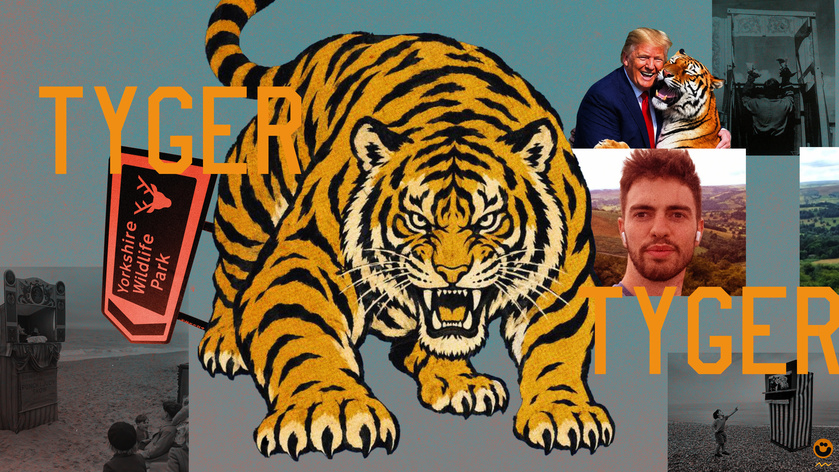
But in the case of ‘William Chapman’ I’ll make an exception. I don’t believe he got mauled - or playfully pawed or even affectionately licked - by a Siberian tiger called Altai in Yorkshire Wildlife Park. I don’t believe the police took 33 photos of the incident. I’m not even sure that William Chapman is a real person.
If you’re unfamiliar with the background to the story, here’s a summary from Morgan on Twitter. Morgan is very good at spotting psyops.
Sooooooo, just so we’re clear, this is what we’re suppose to believe.
“William Chapman”, reportedly a former BBC and ITV child actor, went to the zoo alone, started dancing, filmed the tiger, uploaded the footage, then asked a random woman to photograph him, then ended up jumping 12 feet inside an enclosure with a 200kg Siberian tiger.
(Interestingly, that’s the same reported height Lindsay Clancy fell from, and allegedly the same height Tyler Robinson jumped from. Twelve feet again. What a popular measurement.)
A woman “desperately” tried to stop him, while “witnesses” somehow managed to identify him screaming “stop” and signing “bad” in Makaton during the attack. 🤣Incredible. Apparently, even the fucking tiger attack had with autism subtitles.
Then he died.
Meanwhile, the media have treated us to a fabulous collection of mirror selfies, that are exactly the same dramatic travel photos, and a kitchen portrait featuring a Bible, firearms, a crossbow and an arrow in his mouth.
Makes sense.
Authorities are discouraging circulation of the footage, and the media have already moved on to discussing zoo safety regulations.
I guess it makes sense to people that at a crowded wildlife park, with countless cameras, that there would be ONE video.
What a fucking screenplay. Can’t wait for the BBC adaptation.
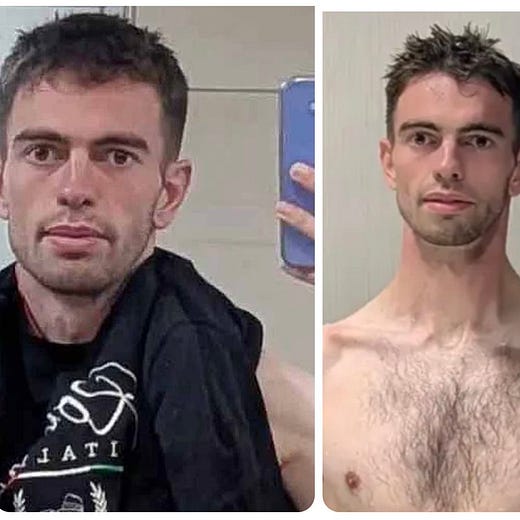

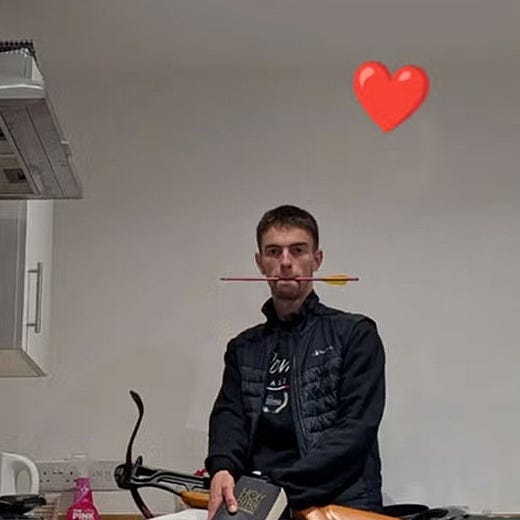
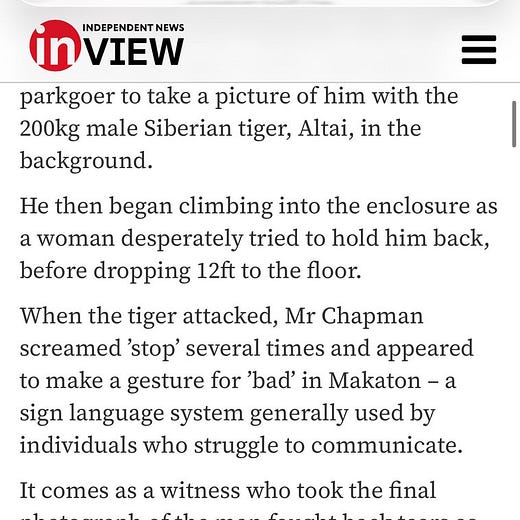
Yes, Morgan. All of this! To those of us who know it seems quite extraordinary that anyone should be taken in by so obvious a scam. Yet the Normies have fallen for it hook line and sinker. And appear to get indignantly defensive when you try to tell them otherwise.
Here are some of the responses I got on Twitter when I called out the fakery.
Is there anything that you don’t think is a conspiracy?
Oh dear. I wondered what became of you. This has become of you. How sad.
You guys are genuinely demented freaks. How do you write this and think "This makes total sense and doesn't make me sound like a complete schizo"
When I say ‘appear’ to get indignantly defensive, that’s because I believe most of these responses aren’t genuine. They are the work of intelligence services operatives and bots whose mission is to poison the wells for truth seekers on social media by implying that they are heartlessly insensitive or deranged - or both.
Here is an example of the ‘you are a heartless bastard’ smear:
READ THE HEARTBREAKING FAMILY STATEMENT FROM YESTERDAY.....he'd been mentally ill for several years, prescribed STRONG medication......he had no idea the danger he was in......do as they ask....STOP posting this video, & vile conspiracy theories....show them respect now🇬🇧
And here is an example of the ‘you are bonkers’ one:
What the fuck are you on. The poor man was obviously suffering from a severe mental breakdown. It's now been confirmed he was suffering from mental illness the last few years by his family. What conspiracy? You people are insane!
Usually, when you click on the account details, you discover that they only joined recently and have a handful of followers, mostly porn accounts. There is no point in engaging with them because it gives them the attention they want and the credibility they don’t deserve. The Mail on Sunday columnist and Twitter warrior Peter Hitchens is forever debating with these fake intelligence services accounts. I used to think that it was because he was a fuddy-duddy Boomer who just doesn’t understand the game. But I, and others, have explained the situation to him so many times - he never answers, which is uncharacteristic because usually he can’t stop himself answering - that I now suspect he knows what he is doing and that he is part of the problem. He’s a dissident - but of the Establishment-licensed variety.
The preponderance of Twitter attacks from dubious sources is, of course, the biggest tell of all that this tiger story is another psyop. If a man really had been eaten by a tiger, the narrative-controllers wouldn’t have bothered to intervene because res ipsa loquitur. The truth doesn’t need propping up, only lies.
By far the most common critical response to those calling out the tiger scam is the ‘But why would they do this?’ question. Here is Morgan again (@MorganC000)
I’m big on asking who benefits. Motive matters. But there’s something deeply inorganic about this response. Dozens of people parroting the same question, “Why would they fake it?” with zero interest in examining the discrepancies. That kind of uniform curiosity about motive, coupled with a complete absence of curiosity about evidence, is peculiar.
Since when did knowing WHY become a prerequisite for questioning WHAT?

Once again, I suspect that most of these responses are from the intelligence services rather than from real people. What the Feds have worked out - not that it wasn’t obvious - is that the biggest barrier Normies have when trying to make sense of ‘conspiracy theories’ is the question of motive.
I joke about this in my revised issue of Watermelons, when I conjure a scene in which Shit Sherlock Holmes goes to investigate a body in the library. The dead man has a knife in his back. But Shit Sherlock Holmes rules that it must have been an accident because if it had been murder he would have been able to work out the motive.
Why is the motive question such a deal-breaker for Normies when it comes to accepting the reality of a ‘conspiracy'? Well let’s use the tiger story as a case study. In order to believe that it was a psyop you would have also to accept that all sorts of decent, apparently trustworthy people were in on the scam: the police, the wildlife park, the family of the alleged victim, the ambulance services, the media, the coronor’s office and so on. For most people, that is just too big a pill to swallow because it would involve radically changing their understanding of the world and the role, therein, of authority figures.
We’re all brought up to believe that the world is essentially a benign one. Sure, we are given to understand, there are one or two bad apples and we need to keep our wits about us. But generally, we imagine that can rely on the system to protect our interests. We expect the police, for example, to defend truth and justice rather than, say, to pretend that a man has been killed by a tiger when he hasn’t. We expect journalists, within reason, to tell us what actually happened in the tiger enclosure, as opposed to what totally didn’t happen in a million years in the tiger enclosure.
This is why it’s so much easier to dismiss the notion of conspiracy with what seems to be the killer question: “But why would they do it?” It gives the reassuring feeling of being logical, rational and unanswerable. After all, just how utterly mind-boggling would it be to have to live in a world where your trusted authorities were actually so untrustworthy - and frivolous and malevolent - that they would publicise fake stories about a man being eaten by a tiger in a wildlife park? Why it would mean these people were capable of lying to you about absolutely anything and everything! And no one would do that, surely?
But, as we so-called conspiracy theorists know, they do this all the time. Deception is our dark overlords’ primary control mechanism. They use it to generate fear, confusion, division - all of which reduce the populace to a state where they are both more malleable and more inclined to crave protection. Protection from the very people who throughout history have used this misplaced trust to crush those beneath them.
These are not things that can be explained in a sentence. This is hard-won information which ‘conspiracy theorists’ have only acquired after many months of research and bitter experience and social ostracism and personal trauma. You can’t just hand it to Normies on a plate and expect them to devour it gratefully. Especially not when they have been trained to view the contents of the plate as if they were poison.
Still, if I had to hazard a guess as to the motivation behind this tiger psyop I’d say that they rarely do these things for one reason alone, so there is a multitude of possible options. These include: to mess with our heads; to test how gullible we are when it comes to AI-generated imagery [is it a coincidence that that poor, blameless tiger is called Altai? They do love their puns, these Cabal psychopaths]; to foment division between various factions - those who feel sorry for the tiger; those who feel that all tigers in captivity should be destroyed lest another such incident happens; those who feel that there should be more regulation; those who want to get cross with conspiracy theorists who deny the reality of this terrible and moving tiger story, etc; as a distraction from something else; as part of the process of hypernormalisation whereby we are continually bombarded with confusing information which we are required to process and accept even though our guts tell us it doesn’t make sense; some weird occultic shit to do with tigers understood only by the initiated; and so on.
One of the more obvious ones, for me, emerged when they published on the front pages of the newspapers that dodgy photo of the alleged victim holding a crossbow, with a crossbow bolt between his teeth, and, of all things, a Bible. [There was also a fake Roman helmet with the paedo symbol on it, but let’s not go there, it gets too confusing]. This, clearly, is to seed in the public imagination the notion that anyone who wishes to hunt or to defend themselves with a cross bow, or who reads the Bible is dangerously unhinged.
And isn’t it interesting that Donald Trump decided to jump on the bandwagon by releasing a tasteless AI video of himself wrestling with that supposed man-eating tiger? Was that the action, would you say, of someone who believed that the tiger incident was anything other than a psyop?
Trump likes playing these games because one of his many acting roles is that of Chaos Agent. What Trump is telling the Normies who believe the tiger story is: “You are all gullible idiots. And because you have demonstrated - not for the first time - that you are such gullible idiots, you have given people like me permission to go on and on abusing you.”
This is how crazy the world is. Once you know this stuff, you can’t unknow it. No wonder the Normies would rather look the other way.