



James Delingpole
Politics • Culture • Writing
Erudite but accessible; warm and witty; definitely not woke
Interested? Want to learn more about the community?
The Lying Media Always Lie. So Why Believe Them This Time?

If ever you’ve fallen victim to a conman’s trickery - as I have on several expensive occasions - one vital lesson you will have learned is the importance of never investing emotionally in the string of plausible lies you are told.

But while this is easy in theory it is very hard to observe in practice. Most of us are trustworthy, decent people who naturally assume good faith in others. This virtue - and it is a virtue, for who wants to live in a world where we treat everyone we meet as a potential deceiver? - makes us ripe for exploitation by the forces of darkness, especially by their leader the Prince of Lies.

That’s why the Bible enjoins us “Put not your trust in princes” and ‘It is better to trust in the Lord than to put any confidence in man.” Even if you’re not a Christian, you will I hope agree that the principle is sound. If I had to recommend the Bible to atheists it would be as an instruction manual on how to survive in a corrupted world where liars rule the roost.

Anyone who has gone down the rabbit hole - Christian or not - ought to be aware by now that the people who run the world do so mainly by deception. This is, after all, the very definition of ‘waking up’: suddenly realising that everything you have been told about key historical events from the Moon landings to 9/11, about major players like William Shakespeare and Winston Churchill, even about the great ‘discoveries’ we have come to call ‘basic science’ is a tissue of lies.

The next step in this learning process is to work out how They do it. It’s actually pretty simple. They control all the major sources of information - the schools, the universities, the publishing industry, entertainment, etc - to ensure that you are fed on a constant diet of bullshit.

I used to be a part of one of these bullshit industries myself. The worst of them all, actually: the mainstream media. Because of the compartmentalisation that applies in all secret operations, I had no idea at the time that the true purpose of my industry was to frighten, mislead and brainwash the populace through misinformation and disinformation. But now that I’m a bit wiser and better informed, I see the process much more clearly.

Take ‘the news’. Most people imagine - and not just those outside the industry but those who work in it - that when a big story breaks on the front pages of all the newspapers it is a real event which has been selected for coverage because of its importance. In truth though, few people have any idea whether a story is real or not - and that includes the journalists covering it.

That’s because in its earliest stages, the story will have been taken ‘off the wires.’ That is, invariably, one of the big media agencies - Reuters, Associated Press, Agence France-Press - will have provided the raw details, which are then rewritten and lightly embellished by individual newspapers and TV news channels. In other words, most news reports are glorified press releases.

If you work as a reporter of the newspapers covering one of these stories, the incentive for verifying the facts is zero. The narrative has already been agreed on - and is being diligently relayed by all your rivals. Imagine trying to approach your editor as, say, a heartrending story is breaking about a bombing at the Boston marathon. What he wants is tales of heroism, personal tragedy and background information on the evil Muslim terrorists responsible. The last thing he needs to hear is some maverick pillock wasting his time with crazy speculation that the whole episode might have been faked.

This is why, even when thousands of well-motivated and sincere reporters all around the world cover the same story they always end up reaching the same conclusions. The lone maverick reporter prepared to jeopardise his career in pursuit of the unpalatable truth may be a staple of the movies - and there’s a reason for that, the movies, of course being another important part of the lie machine - but you rarely find him in real life. Journalists are career-safe pack animals. There is no mileage in being different. It just stops you getting published and ends up getting you sacked.

Just about the only reporters who break this rule are those who can afford - or who can’t afford, but value principles more highly than money - to work outside the mainstream media. A good example is Richard D Hall, the British investigator currently being vilified in some quarters for having dared question the official story about the Manchester Arena tragedy in 2017, when 22 innocents were supposedly murdered by an Islamist suicide bomber at an Ariana Grande concert.

Hall, as even his worst critics would have to admit, is not afraid to risk courting unpopularity. Among the subjects of his previous investigations are Madeleine McCann (probably the world’s most famous missing child) and Jo Cox (certainly this century’s most famous martyred British member of parliament, cruelly murdered in the streets - at least according to all the highly emotive newspaper reports which threatened to derail Brexit - by a deranged lone gunman). By daring to ask tricky questions about such examplars of tragic victimhood, Hall has earned himself the MSM soubriquets ‘disaster denier’ and ‘troll.’

In order for these charges to carry any weight, though, you would first need to demonstrate that all mainstream media accounts of terrorist incidents and other major news events were so accurate as to be beyond questioning. I doubt even regular consumers of the mainstream media would claim that this is the case. As for those who are Awake, they certainly wouldn’t - or at least oughtn’t - for reasons I’ve given above but which I’ll repeat here for the benefit of the slow at the back. To be Awake is, by definition, to realise that all ‘official’ sources, especially the mainstream media, lie to you relentlessly about almost everything.

I only inserted that ‘almost’ in order to cover myself, just in the unlikely event that someone, somewhere, can produce a convincing example of an occasion when the media actually told us the unvarnished truth about something. But such instances, if they exist, are rare as hen’s teeth. When I glance, disgustedly, at my wife’s copy of The Daily Telegraph, for example, I can parse every article and tell you exactly what its underlying purpose is, where it is withholding the truth, and where it is twisting the facts, in order to keep its readership misinformed. The people responsible may not always realise that they are scum. Scum, though, is most definitely what they produce on a daily basis. Just like all the other newspapers and TV channels, which are all the bloody same when it comes down to it, because they all owned by the same Predator Class.

Given that all this is so, I find myself somewhat surprised to be having to defend myself against the charge that I have been ‘misled’ by Hall. And that, in turn, when I had him on my podcast I was misleading my viewers. My viewers are more than capable of deciding for themselves what they think of Hall’s research. Personally I find it very persuasive. Though no one - except maybe those who planned the operation - could tell you exactly what happened in Manchester Arena that night, I’m pretty sure of one thing: it was nothing like the version of events we were presented with in the mainstream media.

When I wrote “except maybe those who planned the operation” I didn’t just do it to win snark points. (Though obviously, that was a massive bonus). I said it also to address one of the more fatuous objections I often see raised whenever the issue of false flag/staged terrorist incidents comes up. It goes along the lines of “I wasn’t convinced by every last detail of his argument.”

There’s invariably someone who makes this complaint after I’ve done another of my podcasts with Ole Dammegard, who specialises in revealing the truth behind such terror events as the assassination of JFK, the murder of Olaf Palme, and the 2011 massacre on Utøya island in Norway. “Rambling and speculative,” said one, after our latest, about the faked assassination of Donald Trump. https://open.substack.com/pub/delingpole/p/ole-dammegard-512? But he was completely missing the point.

The point is this: the people who plan and execute false flag/staged operations are masters of deception with unlimited resources and budgets at their disposal. One of the key areas on which they spend these unlimited budgets is the cover up operation. This can include: faked death certificates; the paying off and disappearance of ‘victims’ to new locations; rigged public inquiries; the abuse of legal process to intimidate investigators; disinformation and misinformation from the compliant press; TV specials reinforcing the official narrative; etc. Should we really be surprised that against so powerful, corrupt and mendacious an Establishment system, independent researchers find it difficult to establish, down to the finest detail, exactly how this or that operation was executed?

Much of the ire currently being directed against Hall derives from his inability to tell us exactly what happened to the 22 people allegedly killed in the Manchester Arena bombing, such as the youngest victim, eight-year old Saffie Rose Roussos. In the immediate aftermath of the bombing, much play was made in the media of “little Saffie’s” death, with prominent photos of her ‘simply beautiful’ face, and tributes such as the one from her headteacher, who said “she was loved by everyone and her warmth and kindness will be remembered fondly.”

I don’t think anyone could have looked at those photos or read those comments at the time without feeling at once moved and angry. But then, the same could be said for all those stories we read after the October 7th attacks in Israel about how 40 babies had been beheaded by the savage killers from Hamas. The more accurate figure for beheaded babies, we learned later, was zero. By that stage, though, the facts were irrelevant: the pliant public had already been whipped into the appropriate state of vengeful frenzy, so, propaganda job done.

Whenever you call into question the reported deaths of children, some people get very upset because they think you are dishonouring the dead - and the pitifully young and innocent dead, at that. I’ve written about this in two earlier essays which you might enjoy - Will No One Think of the (Probably) Fake Children?

https://open.substack.com/pub/delingpole/p/will-no-one-think-of-the-probably? and Israel and Palestine: This Time It Really Isn’t Different

The people who plan these psyops know from long experience that the best way to get the public to buy into their propaganda lies is to bypass the rational part of the brain and appeal directly to the emotions.

Sometimes, often in fact, they do it with dead children, which tend to work a treat. (Remember little Aylan Kurdi, the dead boy washed up on the beach, whose image dominated newspapers for weeks?). Sometimes, they play on more subtle emotions, like, in the case of the first Trump assassination attempt, the notion that quite a few God-fearing Trump followers have that he is on a holy mission to save the world.

Even quite a few of his Awake followers fell for it. Diehard sceptics who normally don’t believe a word they see in the newspapers and who know TV news is a joke were suddenly brandishing the ‘facts’ they’d got from both - the shooter on the roof; the hero firefighter caught in the crossfire, the miraculously slight wound - as unimpeachable truths.

It apparently never occurred to these instant, passionate, it-was-definitely-an-assassination-attempt experts to ask basic questions like: how come this particular rally in the middle of nowhere was flooded with reporters, including one from the BBC, when normally the MSM wouldn’t have touched an obscure, regional non-event like this with a bargepole?

“OK so they lied to us about ‘Covid’, global warming, the Titanic, 9/11, the Beatles, vaccine safety, Ukraine, Evolution, the causes and treatment of cancer, October 6, January 7, 7/7, the Bolshevik revolution, the Moon landings, Winston Churchill, sun cream, JFK, viruses, Princess Di, seed oils, Charles Darwin, Spanish flu, cholesterol, the early history of Britain, AIDs, the translations of the Bible, the Crusades, the Federal Reserve, the Lusitania, Marie Curie, Hollywood, Mother Teresa, the Summer of Love, the Vietnam war, the Boston marathon and a few other things. But I’m still going to trust them on… [insert story here which accords with my prejudices]”

It doesn’t really work, does it?

I think given the media’s track record, the time has long since passed when we should give them the benefit of the doubt on any story they run. If they want us to believe their nonsense, then the burden of proof should lie with them, not with the investigators calling their bluff…

Interested? Want to learn more about the community?
What else you may like…
Videos
Posts
Articles
Why I Want You on My Website (Not Here)

Subscribing via my website — https://www.jamesdelingpole.co.uk — brings everything together in one place.

You’ll get full, immediate access (at least 24 hours before any other platform) to everything I publish: my articles, as well as my Delingpod, Psalms podcasts - including material that never appears on Substack, Patreon, Locals or anywhere else.

More than that, it gives you a direct line in. You can engage properly - like, save, comment etc - and ask questions that actually get answered.

Most importantly, it supports my ridiculously honest, no-holds-barred independent truth-seeking without relying on evil, big tech, third-party platforms.

If you’re already supporting me here or elsewhere, thank you - it genuinely means a lot. But the best place to do that now is my website.

https://www.jamesdelingpole.co.uk/Support/

00:02:00
A prayer request

Please can you all pray for a miracle with my finger. I’ve had the wire out but unfortunately the bone is refusing to knit. Unless a miracle happens in the next fortnight I’m facing a much bigger, nastier op…. So you’ll see why, on balance, I prefer divine intervention and the more of you that pray the easier you make God’s job.

00:01:04
James and Dick’s CHRISTMAS Special 2025

Featuring Dick. And James. And Unregistered Chicken. And possibly some other special guests.

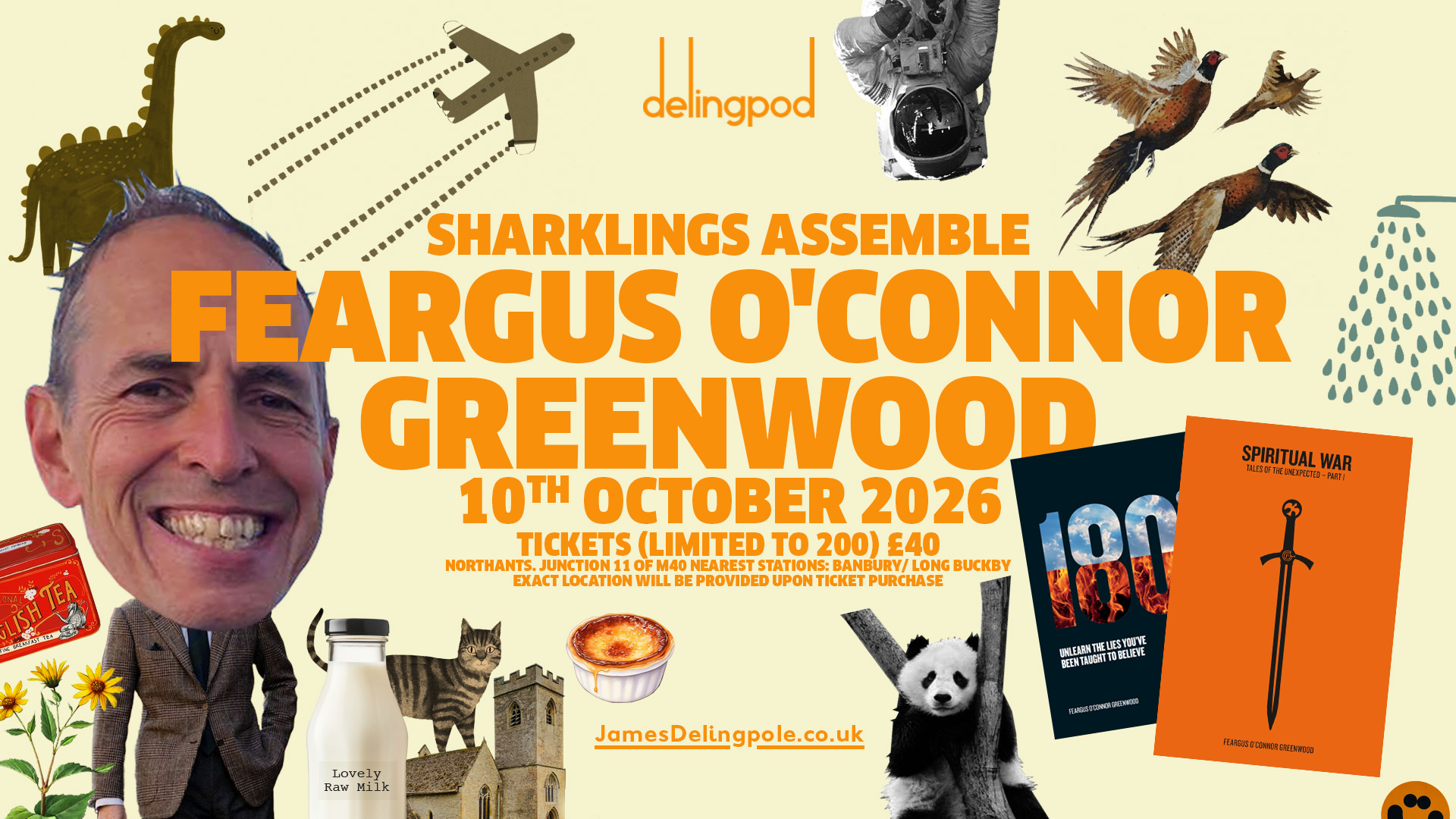
Not included in ticket price but available so you don’t starve/die of thirst: nice pizzas out of wood-fired ovens; street food.

VIP Tickets - £120 including bell-ringing lesson, walk with James, front row seats, church tour

Location is: My neck of the woods. Northants. Nearest stations, Banbury/Long Buckby. Junction 11 of M40.

Friday, 28th November 2025. Starts at 5pm

https://www.jamesdelingpole.co.uk/Shop/?section=events#events

00:02:47

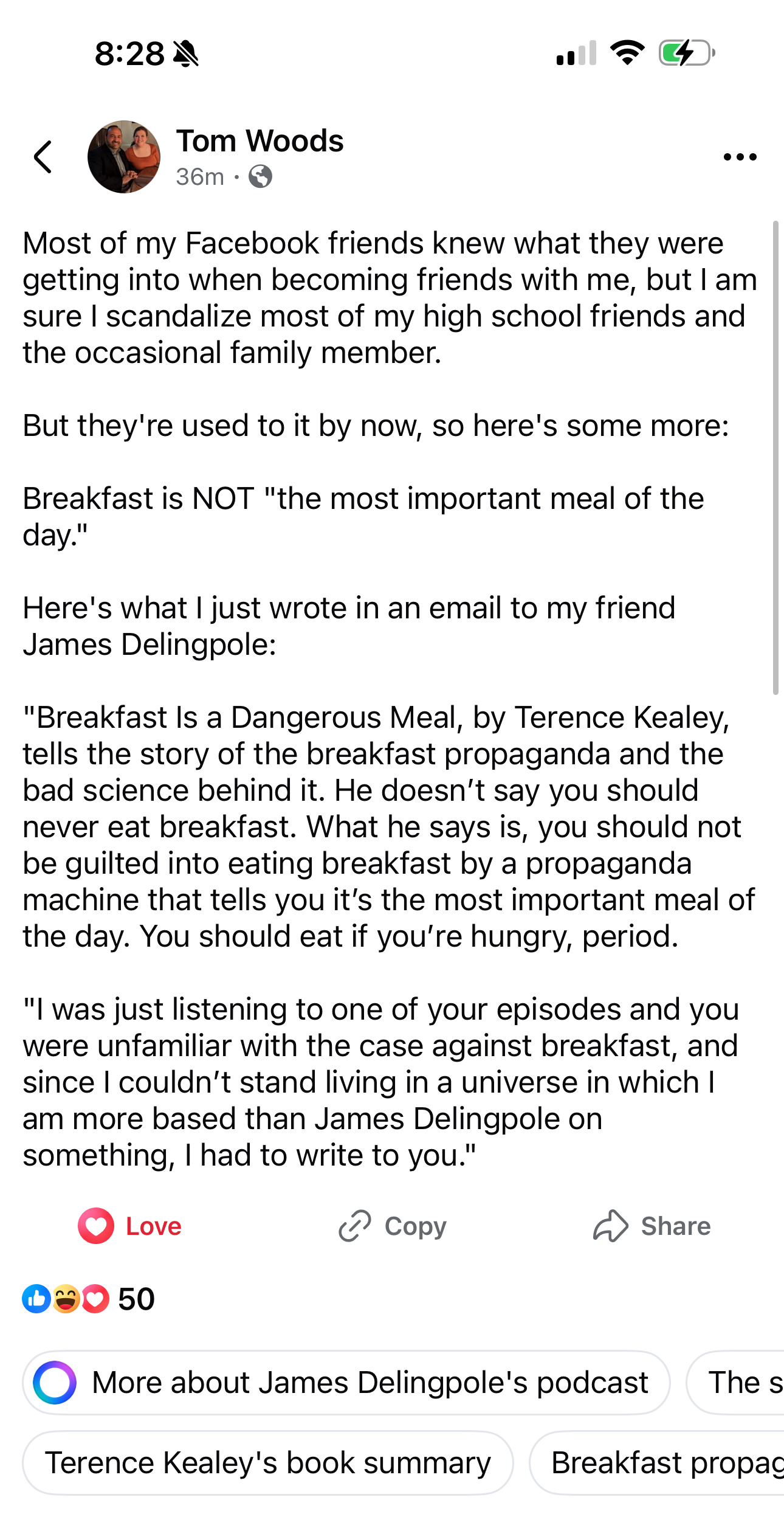
Posted by Tom Woods this morning. I concur! Breakfast is for farmers.

post photo preview
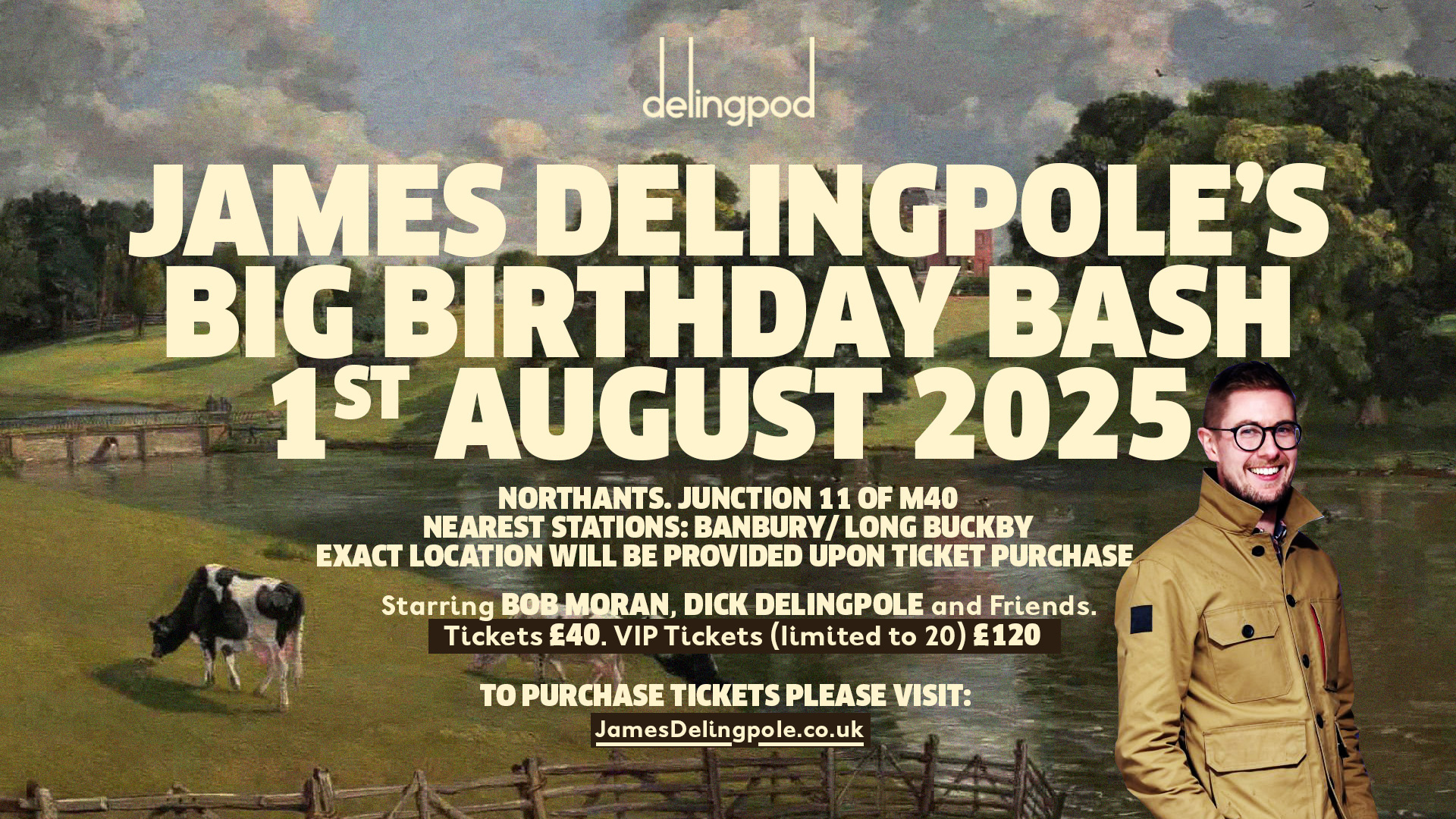
James's Big Birthday Bash - August 1st. Be There!

Because I love you all and want you to be happy, I’d like few things more than if you were ALL able to join me at my James Delingpole Birthday Bash on August 1st.

Unfortunately, numbers are strictly limited. So please don’t be one of those people - I’m the procrastinating type myself, so I know whereof I speak - who sends me a pleading message a few days before the event saying: “Can you squeeze me in?” Because tragically I might not be able to help.

Here’s why I think you’ll enjoy it. The main event is me doing a live Delingpod with Bob Moran and the conversation is going to be great. You know it is. Apart from my brother Dick - who’ll also be appearing, obvs. - there’s probably no one with whom I have a greater rapport than Bob. And, gosh, do we have a lot to talk about: chemtrails, death jabs, dinosaurs, Satanists, the New World Order etc. All the stuff, basically, that you can’t discuss with your Normie friends, but which here we’ll cover freely and frankly because, hey, you’ll be ...

post photo preview
Christianity 1 New Age 0

If you haven’t already - I’m a bit behind the curve here - I urge you to watch this car crash encounter between Christian apologist and scholar Wes Huff and ‘ancient civilisation’ researcher Billy Carson.

It’s an excruciating experience - probably best to watch it on double speed - for a couple of reasons. First, the hapless podcast host/debate moderator Mark Minard is somewhat out of his depth and is also clearly embarrassed at having one of his guests (Carson, sitting right next to him) eviscerated in front of him by his other guest. This causes him to interrupt the debate at intervals and expound well-meaningly but not very interestingly on his own half-baked views on the mysteries of the universe. You feel a bit sorry for him but you do rather wish he’d shut up.

Second, and mainly, it’s painful to watch Carson being outclassed and outgunned by someone who knows and understands his purported field of expertise so much better than he does. Carson was reportedly so upset by the encounter that he ...

post photo preview
How Not to Lose It at Your Dad's Funeral

“How did you manage to keep it together at your Dad’s funeral?” some sympathetic souls have kindly asked. This was in response to a recent piece I wrote on the experience of delivering my father’s eulogy. I thought, rather than reply individually, that I would turn into it into another article which some of you might find helpful.

  1. Celebrate the life rather than mourn the death

When I was planning my father’s funeral service, my immediate thought was to choose lots of appropriately sad music: Elgar’s ‘Nimrod’; poignant hymns like The Day Thou Gavest, Lord, Is Ended; and so on. Luckily I realised that this would probably be a mistake.

At a funeral, the congregation is already sad enough that someone they love has died. You really don’t need to twist the knife by tormenting them with music guaranteed to reduce them to tears: the tears will flow quite naturally anyway.

So for the intro music, I chose something jaunty: The Dambusters March by Eric Coates. As well as being an affectionate nod to my Dad’s National Service career (when he served in the RAF), it’s a popular, jolly, sturdy tune that puts a smile on your face. This made wheeling the coffin down the aisle much less painful.

You probably need one solemn, slow hymn to acknowledge the gravity of the moment. My father had already settled this by naming Eternal Father, Strong to Save as his chosen hymn in the Death Book we gave him to fill in, at his leisure, while he was still alive and well. (Death Books are very useful. Every elderly person should have one: they’re your last chance to declare how you want to be buried, who you want delivering your eulogy, etc. They also forestall family arguments after you are gone: your wishes having been expressed, the decision already made).

But one depressing hymn is enough. The others should be rousing ones that offer everyone the chance to sing their hearts out and relieve some of that pent up emotion. We agreed on Guide Me O Thou Great Redeemer and Jerusalem. We did wonder whether it was really appropriate to include two such belters. But Gary, the excellent vicar at Christ Church, Malvern, confirmed them as suitable choices. A funeral service, he explained, needs to move in waves: a quiet, contemplative, mournful bit in the middle, book-ended by outbursts of life-affirming, death-conquering exultation.

We played the old man out to the tune of JSB’s Sheep May Safely Graze. I mean, it’s such a classic why would you not?

  1. Keep Your Eyes on the Prize

From the moment I woke up on the day of my father’s funeral, I knew I had but one mission: to give my beloved Daddy the send off he deserved. Just writing that word ‘Daddy’ has brought tears to my eyes, which is why it certainly wasn’t going to be allowed to sneak into my eulogy. My job was not to feel sorry for myself but to deliver an oration worthy of the man.

Also, I’m the eldest sibling. When you are the first born - of five - it’s a job for life. No matter how much your brothers and sisters may subsequently eclipse you in terms of fame, fortune or distinction, whenever you gather together you will always instinctively observe the pecking order you had as children. Therefore, as top dog, you have to set an example. You have to be like a Napoleonic-era naval captain on the quarterdeck of his ship-of-the-line. No matter if there is carnage all around you as your decks are swept with grape, your masts are shattered and your ensign is shredded into a tattered rag. Others may fall but you must keep a cool head.

  1. Pretend It’s Not Happening

Of course, keeping a cool head is easier said than done. But for me it seemed to follow quite naturally from my decision to prioritise my delivery of the eulogy. I entered a kind of trance state in which I felt at one remove from the events around me. When the hearse rolled up with my father’s coffin inside, for example, I quickly fought off thoughts like: “Oh no. That’s my dead Pa in there and he’s not coming back.” Instead, I thought, “Gosh. This is all so intense I’m not even going to try to process it. I’m going to act as if it’s more like a dream.”

It works really well as a strategy, I find. The only problem is afterwards when you realise you haven’t really dealt with any of the emotional issues that might have been alleviated had you allowed yourself to sob and weep. Just now I had a relapse of my various ongoing health problems. Michelle, my wonderful osteo, said my cranial rhythms were so constricted it was as if I were suffering from concussion. She ascribed this - because she had come across it before with other patients - to unresolved grief.

  1. Be a Christian

You should try this sometime, if you haven’t already. Having a strong Christian faith makes SUCH a big difference to how you see death. Not for one second, no not for one fraction of a second, have I imagined that I’m not going to be reunited with my father again at the Resurrection. This is a great comfort to me.

I realise that to an atheist this will seem merely like a delusional cope. But crazy as it may seem, we Christians genuinely believe this stuff. It’s not a position we’ve merely adopted because the Bible tells us so or because we find it to be an agreeable way of dealing with the fact that we’re all gonna die. No. Knowing that there’s an afterlife, that death has been conquered through Christ’s sacrifice, is the essence of everything we think and do. We don’t feel superior to those who think otherwise. Just a bit sorry for them because, goodness, it must be hard living in a world as increasingly demanding as this one and believing that this is all there is.

  1. You Need Dick

Among the qualities I didn’t inherit from my father were a meticulous attention to detail and ability to organise things. Luckily my brother Dick did, which is why things went so smoothly. In military terms, I would be the greenhorn platoon commander desperate to find new ways of getting all his men shot; Dick is the grizzled sergeant who makes sure they don’t.

I had just two jobs - funeral service; eulogy - while Dick took upon himself at least a dozen, from collecting copies of death certificates, informing the various utilities, and booking the church and the grave slot, organising the wake - and the music and photos and sound equipment for our Dick and James tribute - to the tricksy business of dealing with a landlord who, understandably, would much prefer it if the estate went on paying rent for all eternity.

This is the advantage of coming from a large family where there is a range of children with different skill sets. I always knew that having lots of brothers and sisters was a blessing. But I never knew quite how much till my father’s death brought us all together more closely than ever.

So that’s my final piece of advice. If you can and it’s not too late: have lots of children!

Read full Article
post photo preview
How to Deliver the Most Important Speech of Your Life
First, Throw Away Your Script...

I have just delivered the eulogy at my father’s funeral. Was it the most important speech of my life? Well, definitely up there. You only get one shot at giving your old man the send-off he deserves, so you need to get it right.

The temptation on these occasions - and this applies equally to events like daughters’ weddings, best man’s speeches etc - is to make your excuses in advance. “People will understand if I don’t deliver. These occasions are so fraught. You never know how you’re going to react,” you may tell yourself. Sure. But do you really want to spend the rest of your life castigating yourself for how much better you could have been?

You could, of course, play for safety. Type out your speech in advance and read it from a script. This will skirt a lot of potential pitfalls: you can rehearse it so you feel comfortable with it; you’ll have timed it so it won’t overrun; you’ll know you’re not going to say anything clumsy or embarrassing because, perhaps with the help of a trusted adviser, you will have carefully edited it in advance; you (or your paid speechwriter) will have tailored it perfectly with a beginning, middle and an end.

But you will never deliver much more than an average speech. This is first because, unless perhaps done by professional actors, scripted readings never sound as natural or engaging or easy-on-the-ear as unscripted ones. Second because a first-rate speech is a living, breathing thing which responds to the moment. And third because nothing is quite so stimulating to the creative impulse nor thrilling to the nervous system nor makes a speech so exciting to deliver as the terror of going out before an expectant audience and not knowing quite what you are going to say.

Obviously, you’ll need some idea of what you’re going to say. If you don’t know roughly what you want to say you shouldn’t be giving a speech. But this isn’t such a problem as you might think because you do already know what you want to say. What you want to say is the single most important thing that needs to be said about the given topic.

In the case of my father, for example, the important thing was this: he was very special.

But almost every one thinks their Dad is special. What I then had to do was work out what exactly made him so special. Otherwise, I would be in danger of regurgitating a splurge of platitudes and, worse, failing in the one job you have when delivering a funeral oration: capturing the measure of the man (or woman) whose life is being celebrated.

A few ideas came to mind. His bloody mindedness. His pathological aversion to following rules. His insatiable curiosity. His joyous discovery in 1965 when the first of his children was born was that his main purpose in life was to build an empire of Delingpoles.

My father loved being the Delingpole patriarch. (It’s a niche role. There really aren’t many of us). And he liked the idea that rather than preparing his children for the world, it was the world’s job to adapt itself to Delingpoles. Though his five children were all very different, they were very recognisably of the species.

That was my next conundrum. What does a Delingpole look like? I decided they had two defining qualities. One, a very distinctive sense of humour: sometimes warped, often inappropriate, invariably piss-taking. Two, a stubborn determination to be themselves regardless of the personal cost in terms of embarrassment, financial security or ability to gain social acceptance.

Now I had my main theme. I make it sound easy but this is only because I am writing about it after the event. What I haven’t yet mentioned is the hours and hours - and hours - of time I wasted, thrashing about in my head and devising all manner of extraneous verbiage which would end on the cutting room floor.

If I’d read a piece like the one I’m now writing, I could have saved myself an awful lot of trouble. The thing you need to keep in mind when you are constructing a speech is how little time you have to say what needs to be said. So there’s no room - or very little - for anything that is not essential to the main theme.

Oh, and don’t worry about jokes. Or off-the-cuff digressions. Or topical remarks. These will all occur to you naturally in the moment, once you’ve had a chance to assess your audience and the general mood. They don’t need to be worked up in advance: indeed they shouldn’t be because then they turn into darlings. And the only thing to do with darlings, you may remember, is to kill them.

With speeches - as with essays - you won’t go far wrong if you stick to the old, basic, tripartite structural rule:

First, say what you are going to say; then say it; then say what you have just said.

Rules are made to be broken, as we’ll see in a moment. But that one keeps you honest and focused on the task in hand, viz, not skittering around like a crazed dog looking for more exciting new ideas to cram in, but finding ways to amplify your main point so as to enable your audience more fully to appreciate it.

Remember, unlike you, your audience haven’t been living with this speech for the last umpteen weeks. This is their first exposure to it. So what may seem to you like overkill may to them feel more like light understatement bordering on incomprehensibility.

And given that your audience are mainly the people on whom the success of your speech stands or falls, you want them onside. This means not just giving them a line of argument they can clearly follow - even if they are elderly and half deaf, which is not uncommon among funeral congregations - but also making them feel wanted and part of the occasion.

That’s why, early on in my address - but not before I’d got over The Hump - I told everyone present that they were part of the family. “Today you are all honorary Delingpoles”, I said. And I meant it because the fact that they’d all turned out to say goodbye to my father on the hottest day of the year told me all I needed to know: that all of these people were discerning enough to have recognised something special in my father; likely he felt the same way about them. It’s worth remembering that at funerals when you’re not close family you can feel a bit of an imposter. “Should I really be here among so much private grief?” you wonder. A quick acknowledgement from the lectern is a reassuring thing to hear.

Now you’re wondering what The Hump is. This is the name given by my old - and now sadly deceased - friend Brian Robinson for the nasty part at the beginning of a speech which you always dread and somehow have to get past. Once you’ve over The Hump, you’re cooking with gas. And The Hump itself need not be a problem, Brian (a former actor turned professional speech coach) advised. You just need to acknowledge its existence and tackle it head on by preparing for it and dealing with it rather than ignoring it and hoping it will go away.

My biggest challenge, I decided, would be to find an anecdote which simultaneously grabbed the audience’s attention, set the tone of the eulogy (affectionate, amused, upbeat, funny not sad) and didn’t outstay its welcome.

On these occasions - seriously: try it! - I find that appealing to God makes all the difference. I prayed for His help in delivering a eulogy worthy of my father. And God came up trumps by supplying me with the perfect anecdote.

It went roughly like this.

“The first time I realised my father was different was 52 years ago when I was sent off to board at a prep school only about half a mile from where we are now. All the other eight year olds knew how to kick a football, pass a rugger ball and catch a cricket ball. I could do none of the above because my father had never shown me. But I was the only boy who knew the Latin name for the common European wall lizard.”

The reason it works is because it’s funny (well I think so), it hints at the theme which will be enlarged on in the body of the eulogy, it makes a geographical connection with both the location and the audience, it doesn’t last more than a minute, it’s easy to remember (as deep-seated personal recollections always are) and it ends with a clearly defined punchline.

But you’re still not over The Hump just yet. First you must make the transition from your grabby intro to the speech proper. This isn’t easy because you’ve likely paused to allow the audience to appreciate the punchline of your opening anecdote, giving them a chance to laugh as they’ve probably been gagging to do because funerals can be so tense. So how do you do this?

Well the solution I came up with, more or less on the spot because at this point I was letting nervous energy and divine providence take care of the heavy lifting, was to acknowledge what an awesome privilege but also a terrifying responsibility it was to be the one who has to deliver your father’s eulogy. I then observed how very much my father would have disapproved of my trying to do it without any notes, it being such a huge risk to take at an occasion so important - and surely, I ought at least to have a safety net ready just in case.

“But it’s your fault, Pa,” I said. “You bred us this way!” Which is true. He did. He never stopped trying to give us advice on the courses we should take in life but we never ever listened to him and I think he took pride in our utter obliviousness to his wishes. It was a sign that we were the free spirits that he wanted us to be and hoped we would be.

From that point on it was almost plain sailing. All we needed now was a pay off: something to reward the audience for their patience and give them the sense of a speech satisfyingly concluded; but also, more importantly, something that left you with the feeling: “Yes. This was truly special man we’ve just been celebrating. And we’re all going to miss him greatly.”

I decided to break the “Say what you’re going to say; say it; say what you have just said” rule by introducing a sub theme. This was because I had belatedly realised that I had something else very important I needed to say about my father. It had only occurred to me in the weeks after his death when my head was suddenly awash with memories of him and I was trying to make sense of them, trying to work out who he really was. You think you know your father when he is alive but you don’t because you are too busy taking him for granted. Only when he has gone do you start asking yourself: “Who actually was this person whom I’ve now irretrievably lost?” When he’s alive he’s your dad and this relationship colours everything you think about him. But when he’s gone you find yourself trying to understand the world as it might have been from his perspective instead of from yours.

What stood out for me was what a blinder he had played with the cards he’d been dealt in life. Anyone - well, almost anyone: probably not my father who was never much cop at bridge - can win a hand when they’re holding all the Kings and Aces. But it’s how you play the average hands or the shitty hands that are the truer mark of character. Though my old man was born to a life of relative privilege - it was neither easy nor conventionally successful. He suffered bouts of depression; he was cruelly cut out of his father’s will; his first two marriages ended in divorce; his business ventures failed; he had never wanted the career that was forced on him by his father and would have been much happier, probably, as an academic or some kind of maverick, independent researcher or author. Yet no one in that church would have considered him a failure for one second. Because he wasn’t. On the contrary, he repeatedly turned what could have been disaster into triumph by resolutely focusing on the main prize.

And what was this main prize? Hard to define, exactly, but we all had a sense of it in our hearts because it was why we were all there celebrating the life of a man who in his various ways had meant so much to us. As I wrote in my Spectator tribute - which, rather sweetly, the undertaker Georgia placed in his coffin so he could digest it at leisure - I grew almost weary of being told by people who had met him what delightful company my father was. He was both interesting (RAF Chinese language specialist; racing driver; guppy breeder; reptile and amphibian collector; inveterate traveller; etc) and interested, always curious in other people, always wanting to find out more. That’s why on his gravestone, we shall be inscribing one of his favourite catchphrases: “What else do you know?” His desire for new information was insatiable.

This led naturally to my conclusion. I quoted the epitaph on Sir Christopher Wren’s tomb. A bit of a cliche, but apposite. Si monumentum requiris, circumspice. Wren’s epitaph referred to his greatest creation, St Paul’s Cathedral. My father’s to the place he occupied in the memories of all those people - perhaps 150, not bad for a 91-year old who’d outlived all his friends - who’d come to the church to see him off.

Goodbye Pa. We’re going to miss you terribly. But you’re going to live on in all sorts of ways that you could never have imagined. This piece, for example. Someone, somewhere is going to find it useful or comforting or even inspirational. And it’s you they should thank for that, not me.

Read full Article
post photo preview
Don't Feed The Demons!

The other day someone wrote something infuriating on the internet which required an angry rebuttal. This happens to me quite a lot, as I suspect it does to you. I had many pressing things to do that morning which demanded my attention - a tribute to write for the Spectator about the death of my beloved, favourite hunter Carpenter; arrangements to make for my father’s funeral; and any number of urgent gardening tasks to fulfil in order to keep my wife happy.

But really this angry rebuttal could not wait. So, poisoned keyboard at the ready, I set about my work. The problem was that no matter how hard I tried, I could never strike a sufficiently satisfying note. I tried cattily sarcastic; then loftily superior; then cool, restrained but implacable; then charming and conciliatory but not really. Numerous drafts and far too many minutes later, I was still no closer to my goal - probably because I wanted to achieve too many contradictory effects simultaneously. On the one hand I wanted to crush, humiliate, mock and destroy. On the other I wanted to set the facts straight in such a way as to prove beyond all reasonable doubt that The Truth was on my side. I also wanted to show myself to be the better person: the good guy in this ugly feud with whom everyone reading it should identify.

https://www.jamesdelingpole.co.uk/Writing/Articles/why-we-can-t-all-get-along?preview=1

Then suddenly I realised - “****!” - I’d just missed the first fifteen minutes of my gym class. So carried away had I been my righteous desire for vengeance over something ineffably trivial and forgettable that I had stopped myself doing something that was actually good for me; something I had been looking forward to all morning; something far more valuable and life enhancing than getting involved in yet another silly, pointless, worthless row with some nonentity.

At times like this, I’m reminded of the words of David in Psalm 37.

Leave off from wrath; and let go displeasure; fret not thyself else thou shalt be moved to do evil.

Nothing useful would have been achieved had I responded to the person who had irked me. However cunningly I had phrased myself, they would have still taken umbrage and would have been confirmed in their view that I’m loathsome, arrogant, entitled, petulant, controlled opposition, closet MI5 etc.

This is because many - though not all - of the people who have a go at you on social media are not doing so in good faith. They’ve already made up their mind what they think about you. At this point, even if you were to walk towards them across a lake, heal their genital warts and transform all their bottles of Tesco plonk into Chateau Cheval Blanc ‘47, they’d still have you down as an obvious Wrong ‘Un.

Again, the scriptures have some invaluable words to say on this subject.

And whosoever shall not receive you, nor hear your words, when ye depart out of that house or city, shake off the dust of your feet.

Yes, specifically this is Jesus - in Matthew 10:14 - advising His disciples how best to spread the gospel. But like so much in the Bible - which I consider to be an instruction manual on how to navigate a fallen world - it carries many broader, practical implications.

Nobody is universally liked. Not even Jesus. (Indeed, especially not Jesus). So there’s no point trying to win battles with the people who hate you because all it does is leech away the valuable time you’d be better off spending on the people who like you and are receptive to your message.

I’ve written already about the destructive spats which have arisen of late in the Awake Not-a-Community. No doubt they feel incredibly important to the people participating in them. But the majority - I suspect, the vast majority - of Awake types are thinking: “What IS this crazy shit? Why do we have to take sides in this argument that is being thrust in our face like it’s the Wars of the Roses and we have to declare for the Yorkists or the Lancastrians on pain of death? Why can’t we just have another podcast or post where we learn something useful about the real baddies we’re facing in this epic struggle between good and evil, either that or one that’s fun and where can at least have a laugh?”

So it’s to this majority that in future I shall try to direct my energies. Note that word ‘try’, because I doubt very much I will always succeed. The problem with these little hate-fests is that they are so incredibly seductive. We all need our dopamine hits - the Cabal have trained us to do this by giving us iPhones and social media and so on - and just as the Normies have their kickyball to get them all worked up, distracted and controlled, so we in Awake world have our periodic witch-hunts and bouts of purity spiralling and hanging-drawing-and-quarterings.

And sometimes it’s FUN being bitchy and spiteful and appearing to win. I look at some of Milo’s ripostes on Twitter and think: “Go Milo! You so totally OWNED that awful person!” Owen Benjamin, another character I admire, is pretty good at this stuff too. But it requires a lot of dedication and effort. You have to be perpetually on it if you want to keep the whole swarm of those pesky mosquitos continually swatted. And what I’m wondering is: is it really worth the time and energy?

What I also wonder - hence the title of this piece - is: “And isn’t it just feeding the demons?” Whenever I’m tempted to pile into one of these spats, I hear a voice in my head going: “But what’s the point of reciting Psalm 37 every day if you’re going to treat it like empty words which you can casually ignore?” Then I hear the counter argument in my head which goes something like: “Oh come on! You’re allowed a bit of leeway. Spiking people who deserve it is satisfying and fun. Your fans love it because it shows you being witty and on-brand. You’re not a monk, for goodness sake. You’re a high class edge lord.”

I trust the first voice, though, more than I do the second. What I know about demons - which I believe are totally real, of course - is that they feed off negative energy. They love generating rows and they have several millennias’ worth of experience to show them exactly which buttons to press in order to achieve the desired effect. If they can lure you into the fray by saying “Hey - it’s naughty but you’re good at it and you know you love it!” then that’s the bait they’ll use. But they’re equally adept at appealing to what you think is your better nature, viz: “My motives are pure. I am a selfless servant of the truth and it matters not how many people I upset nor how much glorious martyrdom I suffer at the hands of those doubters who think I have gone too far, for I am the paladin of justice and right is on my side.”

Of course, having made this argument I recognise I have now made myself an open target for those mosquito swarms. “Yeah but last month you said this…!” or “But you’re always accusing people of being Controlled Opposition.” True but - re-read the piece, moron! [sorry God] - I never said I was a saint. I do aspire to be one, for that is the Christian ideal, but being a sinner I fail more often than I succeed. That’s one of the reasons I have to write pieces like this one. I need to remind myself, and anyone else who will listen, that this spiritual battle we are fighting ought to be front and centre of everything that we do and think; and that the moral and behavioural restraints that Christianity seeks to impose on us are not there (as the devil would pretend) to turn us into sanctimonious prigs in thrall to a capricious sky fairy. Rather, these restraints are there to help us and protect us and make us better.

That is what I meant earlier when I talked about the Bible being a practical survival guide. It’s an advice manual full of tips that really work in day-to-day life. As an example of this let me tell you what happened recently after someone really had a go at me in the comments on Substack. He called me out as a liar, a fraud, a ‘Chaos Agent’, implied I was only using scripture to give myself a kind of fake ethical legitimacy, that I was making a mockery of my audience, etc etc. It could have been quite hurtful. Actually, it was quite hurtful - especially coming from someone whose intelligence and scholarship I admired, and with whom I’d hitherto had friendly dealings on my podcast.

So, naturally enough, my immediate urge was for dire vengeance. In my feverish, injustice-traumatised brain I began working on the perfect killer riposte.

Then I thought. “Wait a second. Those demons really are desperate for your attention and you’re in strong danger of giving it to them. Surely there is a better way?”

And there was. Listen to my latest podcast with Robert Frederick (aka Hidden Life Is Best). I think you’ll love it because it’s really, really good. But it would never have happened if I’d fed those demons.

https://locals.com/jamesdelingpole/feed?post=8012229

Read full Article
See More
Available on mobile and TV devices
google store google store app store app store
google store google store app tv store app tv store amazon store amazon store roku store roku store
Powered by Locals